Children and young people aged 5 to 18 should get an average of at least 60 minutes of moderate to vigorous physical activity a day across the week, according to the UK Chief Medical Officers. That can be PE, play, sport, walking or cycling to school and after-school clubs. They should also mix up the types of activity to build movement skills, muscles and bones, and sit still for less time.
How much exercise do children need?
Children aged 5 to 18 need an average of at least 60 minutes a day of activity that makes them breathe faster and feel warmer, worked out across the whole week. The UK Chief Medical Officers’ physical activity guidelines set out three things for this age group.
- Do moderate to vigorous physical activity for an average of at least 60 minutes per day across the week. This can include PE, active travel, after-school activities, play and sports.
- Do a variety of types and intensities of activity across the week to develop movement skills, muscular fitness and bone strength.
- Spend less time being sedentary, and when physically possible break up long periods of not moving with at least light activity.
The word average matters. Until 2019 the advice was at least 60 minutes every day. The Chief Medical Officers changed it because the evidence did not support a strict daily minimum, and most studies of children’s health measured an average of 60 minutes a day. So a quieter Monday can be balanced by a busy Saturday, as long as the week adds up to around 420 minutes or more (our calculation from 60 minutes a day over 7 days).
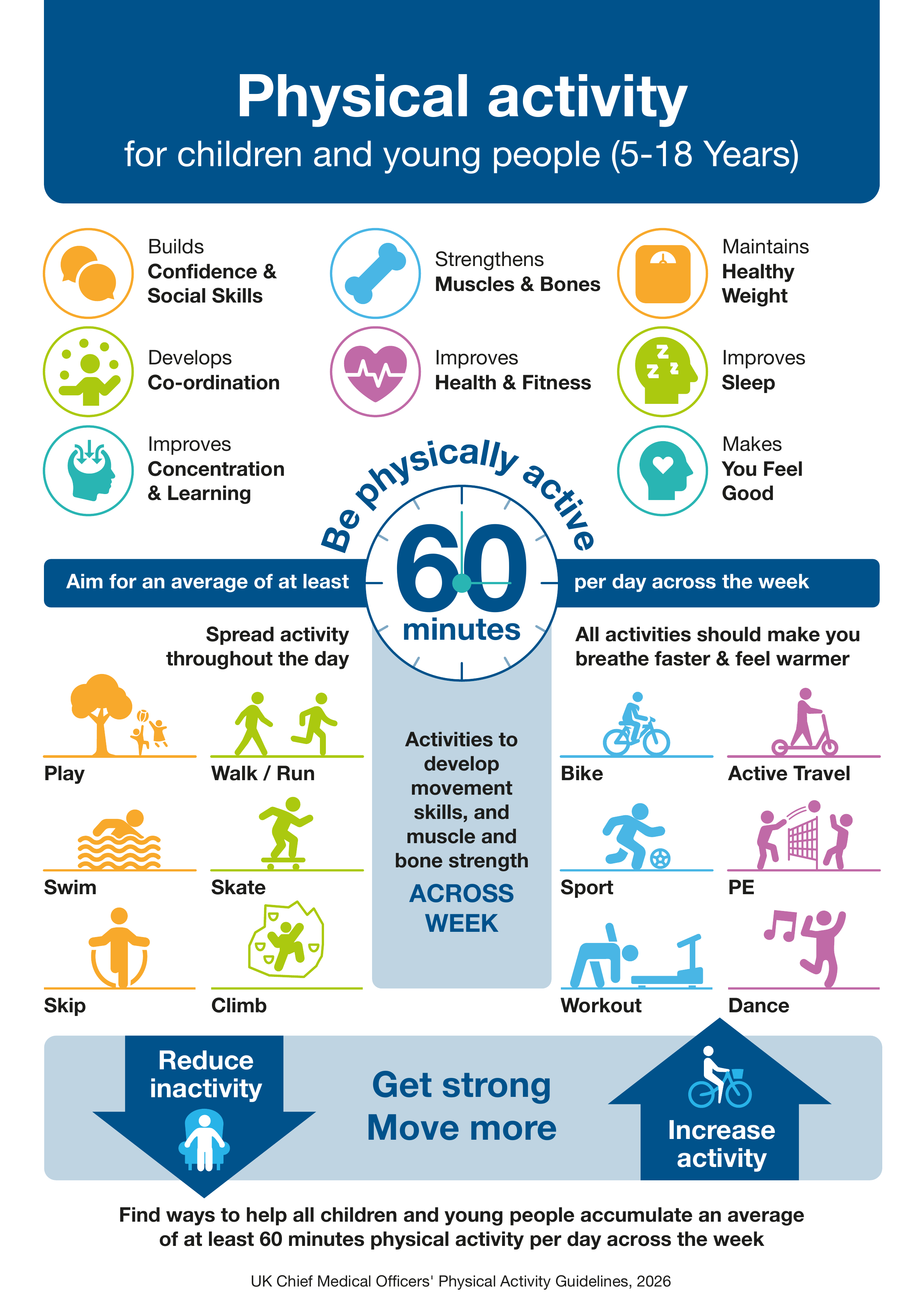
The infographic on this page is the Department of Health and Social Care’s one-page summary of the guidelines for 5 to 18 year olds, updated in July 2026. The same advice applies in England, Scotland, Wales and Northern Ireland.
What counts as moderate and vigorous activity for children?
Moderate activity raises the heart rate and makes a child breathe faster and feel warmer. Vigorous activity makes them breathe hard and fast. The NHS suggests a simple check. If your child can still talk but not sing, they are working at a moderate level. The Chief Medical Officers use the same talk test, and add that struggling to talk without pausing is a sign of vigorous activity.
Plenty of everyday things count. The NHS lists these examples of moderate activity for children and young people.
- Walking to school or walking the dog
- Playground games with jumping, running and catching
- PE lessons
- Sports such as football or tennis
- Swimming, skipping and dancing
- Skateboarding, rollerblading and cycling
The Chief Medical Officers found broad support for the health benefits of vigorous activity for children, but no strong evidence for a set number or length of sessions. Short bursts count, because children rarely stay active in long blocks and it is the total time that matters for health.
Muscle and bone strengthening activities for children
Children should do a range of activities across the week that build movement skills and strengthen muscles and bones. There is no fixed number of sessions. The first 2019 version of the infographic said to include muscle and bone strengthening activities 3 times per week, but it was corrected in September 2019 to say “across the week” to represent the guidelines more clearly.
The NHS gives these as examples of activities that strengthen muscles and bones.
- Gymnastics
- Football
- Jumping
- Martial arts
- Sit-ups, press-ups and similar exercises for young people
- Resistance exercises with bands, machines or handheld weights for young people
Movement skills such as running, jumping, throwing and catching matter too. The Chief Medical Officers say children who are more skilled at moving tend to be more active, and the link works both ways. Trying lots of different activities is linked with children feeling more competent, and children who feel competent are more active.
How much exercise should children get at school?
The usual benchmark is 30 minutes of the daily 60 during the school day and 30 minutes outside school. Sport England’s Active Lives Children and Young People Survey for the 2024-25 academic year says government guidelines recommend that split, and it found 46% of children in England met the 30 minute mark during school hours, while 57% met it outside school.
School time includes PE, active break times, lunchtime play and activities such as a daily run or walk. The rest comes from the journey to and from school, clubs, family time and weekends. Sport England found 60% of children walk, ride or scoot to school, while two in five are taken by car. Children aged 7 to 11 are the most likely to be driven (50%).
Schools in England are also getting new money for sport. The Department for Education announced in May 2026 more than £1 billion for school sport over three years. That includes £580 million for a new PE and School Sport Partnerships Network that will replace the PE and Sport Premium and be fully running from spring 2027, almost £200 million for sports facilities and a one-off £100 million PE Premium for primary schools during the changeover.
Sitting less and breaking up screen time
Children should cut down on time spent sitting or lying still and break up long spells with some movement, even light activity. The UK guidelines don’t set a daily limit for screen time or sitting. The Chief Medical Officers say there is not enough evidence to set a threshold, though higher levels of sedentary behaviour in young people are weakly linked with more obesity and lower fitness.
Sedentary time covers more than screens. The Chief Medical Officers include watching TV, reading, using a computer, sitting while playing video games and travelling in a car. The World Health Organization says that in children and adolescents more sedentary time is linked with more body fat, poorer heart and metabolic health and fitness, worse behaviour and less sleep.
In practice this means getting up between long spells of homework or gaming, walking short journeys instead of driving, and swapping some sitting time for light activity such as tidying up, playing outside or walking the dog.
Why physical activity matters for children
Being active helps children’s bodies and minds in ways that go well beyond fitness. The Department of Health and Social Care infographic lists eight benefits for 5 to 18 year olds.
- Builds confidence and social skills
- Develops co-ordination
- Improves concentration and learning
- Strengthens muscles and bones
- Improves health and fitness
- Helps maintain a healthy weight
- Improves sleep
- Makes children feel good
The Chief Medical Officers also note that activity levels in childhood tend to carry on into adult life, which is one reason they say it is important for all children to be as active as possible. The World Health Organization links regular activity in children and adolescents with better physical fitness, heart and metabolic health, bone health, thinking skills and mental health, and with less body fat.
Sport England’s survey points the same way for wellbeing. It continues to find a positive link between how active children are and their mental wellbeing, and it cites research valuing the wellbeing boost from being active at £3,100 for 7 to 11 year olds and £4,300 for 11 to 16 year olds.
How many children get enough exercise?
About half of children in England meet the guidelines. Sport England’s Active Lives survey found 49.1% of 5 to 16 year olds (3.6 million) averaged at least 60 minutes a day in the 2024-25 school year. That is the highest level since the survey started in 2017-18, when it was 43%.
| Activity level, England, 2024-25 | Share of children aged 5 to 16 | Number of children |
|---|---|---|
| Active (an average of 60 minutes or more a day) | 49.1% | 3.6 million |
| Fairly active (an average of 30 to 59 minutes a day) | 22.5% | 1.7 million |
| Less active (less than an average of 30 minutes a day) | 28.4% | 2.1 million |
Activity varies by age. Children in school Years 1 and 2 (ages 5 to 7) and Years 7 and 8 (ages 11 to 13) were the most active at 53%, while Years 3 and 4 (ages 7 to 9) were the least active at 42%. Teenagers in Years 9 to 11 (ages 13 to 16) were at 49%. Money matters too. Sport England found 58% of children from the most affluent families were active, against 45% from the least affluent, and says that gap is widening.
In Northern Ireland, the Department for Communities’ Experience of sport by young people 2025 report found 98% of 11 to 16 year olds had taken part in sport or physical activity in the previous year and 66% belonged to a sports team or club. Taking part at all is a lower bar than meeting the 60 minute guideline, so these figures aren’t comparable with England’s.
Across the world the picture is worse. The World Health Organization says 86% of adolescents aged 11 to 17 had fewer than seven active days in the last week, and one in four had no active days at all.
Which activities do children do most?
Active play, active travel and team sports are the most common ways children in England get moving. Sport England found 64% of 5 to 16 year olds did active play or informal activity in the last week, 61% used active travel and 58% played team sports. What children do changes a lot as they grow up.
| Age group | Most common activities in the last week |
|---|---|
| Ages 5 to 7 (Years 1 to 2) | Active play 83%, active travel 82%, swimming 53%, going for a walk 53%, dance 45% |
| Ages 7 to 11 (Years 3 to 6) | Active play 71%, team sports 65%, active travel 55%, running 38%, gymnastics, trampolining or cheerleading 36% |
| Ages 11 to 16 (Years 7 to 11) | Team sports 58%, active travel 56%, active play 51%, going for a walk 34%, gym or fitness 33% |
Figures are from Sport England’s Active Lives Children and Young People Survey for the 2024-25 academic year. Active play includes informal activity such as playing games outside.
Team sports become more important with age and so does the gym, while walking, dancing and swimming are most common among the youngest children. Running, including the active mile many primary schools use, peaks between ages 7 and 11.
Do boys and girls get the same amount of exercise?
No. Boys are more active than girls at every age, a pattern the Chief Medical Officers say shows up in both UK and global evidence. In England, Sport England found 52% of boys met the guidelines in 2024-25 compared with 46% of girls. The gap of 5.9 percentage points is narrower than in 2017-18 (7.1 points), but it is still widest among 13 to 16 year olds at 7.9 points.
Enjoyment shows a similar split. In Northern Ireland, 72% of boys said they enjoyed sport or physical activity a lot compared with 59% of girls, according to the Department for Communities. Globally, the World Health Organization found 28% of adolescent girls reported no active days in the past week, against 22% of boys.
Closing the gap between boys and girls, and between richer and poorer pupils, is one of the stated aims of the new school sport network announced by the Department for Education.
Physical activity guidelines for under-5s and disabled children
Younger children and disabled children have their own guidelines. Guidelines for under-5s count total daily activity at any intensity, and disabled children and young people have a lower starting target.
| Group | What the UK guidelines recommend |
|---|---|
| Babies under 1 | Active several times a day, including at least 30 minutes of tummy time spread through the day for babies who aren’t yet mobile |
| Toddlers aged 1 to 2 | At least 180 minutes (3 hours) a day of activity at any intensity, including active and outdoor play |
| Pre-schoolers aged 3 to 4 | At least 180 minutes a day, including at least 60 minutes of moderate to vigorous activity |
| Children and young people aged 5 to 18 | An average of at least 60 minutes a day of moderate to vigorous activity across the week, plus a variety of activities for skills, muscles and bones |
| Disabled children and young people aged 5 to 18 | 20 minutes of activity a day, in smaller chunks if needed, plus challenging but manageable strength and balance activities 3 times a week |
The under-5s and 5 to 18 rows come from the UK Chief Medical Officers’ guidelines. The row for disabled children and young people comes from the NHS guidance, which is based on the 2022 guidelines for this group.
Sport England found children with a disability or long-term health condition were just as likely to meet the 60 minute guideline as those without (49% and 50%).
What changed in the 2026 update?
The advice for 5 to 18 year olds is the same as in 2019. In July 2026 the Chief Medical Officers republished their report in a new format with a new foreword, newer evidence in the adult section and a revised introduction, and the Department of Health and Social Care replaced the children’s infographic with an updated design. A Welsh language version of the infographic followed a week later.
The bigger change for children came in 2019, when the daily minimum of 60 minutes became an average across the week and the advice on muscle and bone strength moved from a set number of sessions to variety across the week. The Chief Medical Officers say the next full update is expected in 2030, working with the World Health Organization.
How to help your child be more active
The guidelines say there is no single right way for children to be active. The focus should be on finding activities they enjoy and creating chances to move. For children who are not very active, any increase helps.
- Walk, scoot or cycle for short journeys, including the school run where it is safe.
- Spread activity through the day. Ten minutes here and there adds up across a week.
- Let younger children play outside freely, with running, climbing and jumping.
- Try different sports and activities, so your child builds skills and finds something they like.
- Break up long spells of screen time or homework with a few minutes of movement.
- Be active together as a family at weekends, when there is more time to make up the weekly total.
The NHS advises getting medical advice first if your child has a health condition, choosing exercise suited to their age and ability, starting new activities slowly and using protective gear for things like cycling and skateboarding.
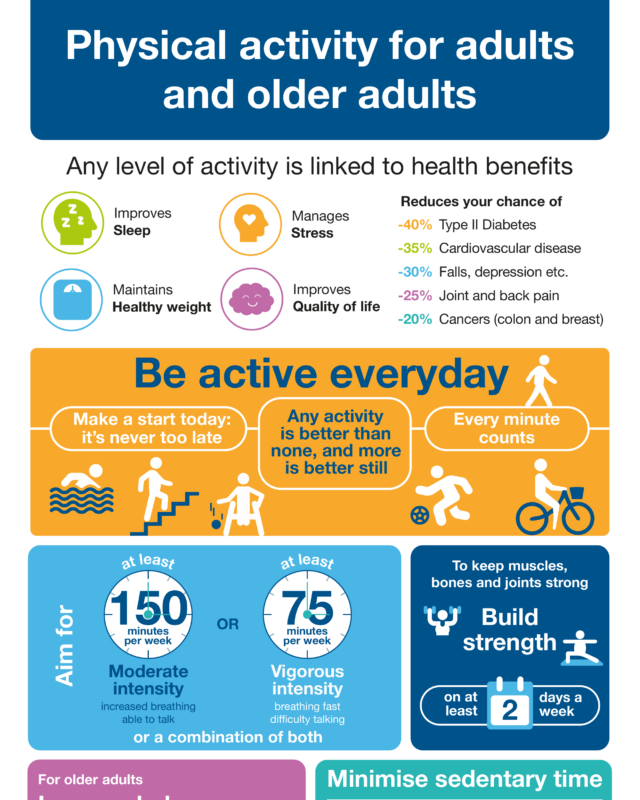
For the adult version of this advice, see our guide to the UK physical activity guidelines for adults.
Questions about children’s physical activity
How much exercise should a child get per day?
Children aged 5 to 18 should average at least 60 minutes of moderate to vigorous activity a day across the week. Some days can be lighter and others busier, as long as the weekly total averages out to an hour a day. Children aged 1 to 4 should be active for at least 3 hours a day.
How much exercise should a teenager get?
Teenagers follow the same guidelines as younger children up to age 18, which is an average of at least 60 minutes a day of moderate to vigorous activity, plus a mix of activities that build muscles and bones. At 19 the adult guidelines apply, which are 150 minutes of moderate activity a week plus strength work on 2 days.
Is 2 hours of exercise a day too much for a child?
For most healthy children, no. The 60 minutes in the guidelines is a minimum average, not a limit, and the Chief Medical Officers say that in general more activity brings more health benefit. The NHS advises building up new activities slowly and choosing exercise suited to a child’s age and ability, and getting medical advice if your child has a health condition.
Can children lift weights?
Yes, with care. The NHS says young people can use weights for resistance exercise if a qualified adult trains them to use the weights correctly and supervises them. Younger children can build strength with activities such as climbing, gymnastics and jumping games.
Does walking to school count as exercise?
Yes. Walking, cycling or scooting to school all count towards the 60 minutes if they make your child breathe a bit faster and feel warmer. The NHS lists walking to school as an example of moderate activity for children.
Do disabled children have different physical activity guidelines?
Yes. Disabled children and young people aged 5 to 18 should aim for 20 minutes of activity a day, split into smaller chunks if needed, and do challenging but manageable strength and balance activities 3 times a week, according to the NHS.
Sources
- Department of Health and Social Care, Physical activity guidelines, children and young people (5 to 18 years), infographic updated July 2026 (the infographic on this page, with its text version)
- UK Chief Medical Officers, UK Chief Medical Officers’ physical activity guidelines, updated July 2026
- NHS, Physical activity guidelines for children and young people
- Sport England, Active Lives Children and Young People Survey, academic year 2024-25 report, published December 2025
- Department for Communities (Northern Ireland), Experience of sport by young people in Northern Ireland 2025, published November 2026
- Department for Education, £1bn boost to PE and school sport to end fitness postcode lottery, May 2026
- World Health Organization, Physical activity fact sheet, November 2026
Contains public sector information published by the Department of Health and Social Care and licensed under the Open Government Licence v3.0. The infographic is reproduced unchanged and carries no departmental logo. Its use here does not imply any endorsement by DHSC. This page is general information, not medical advice.