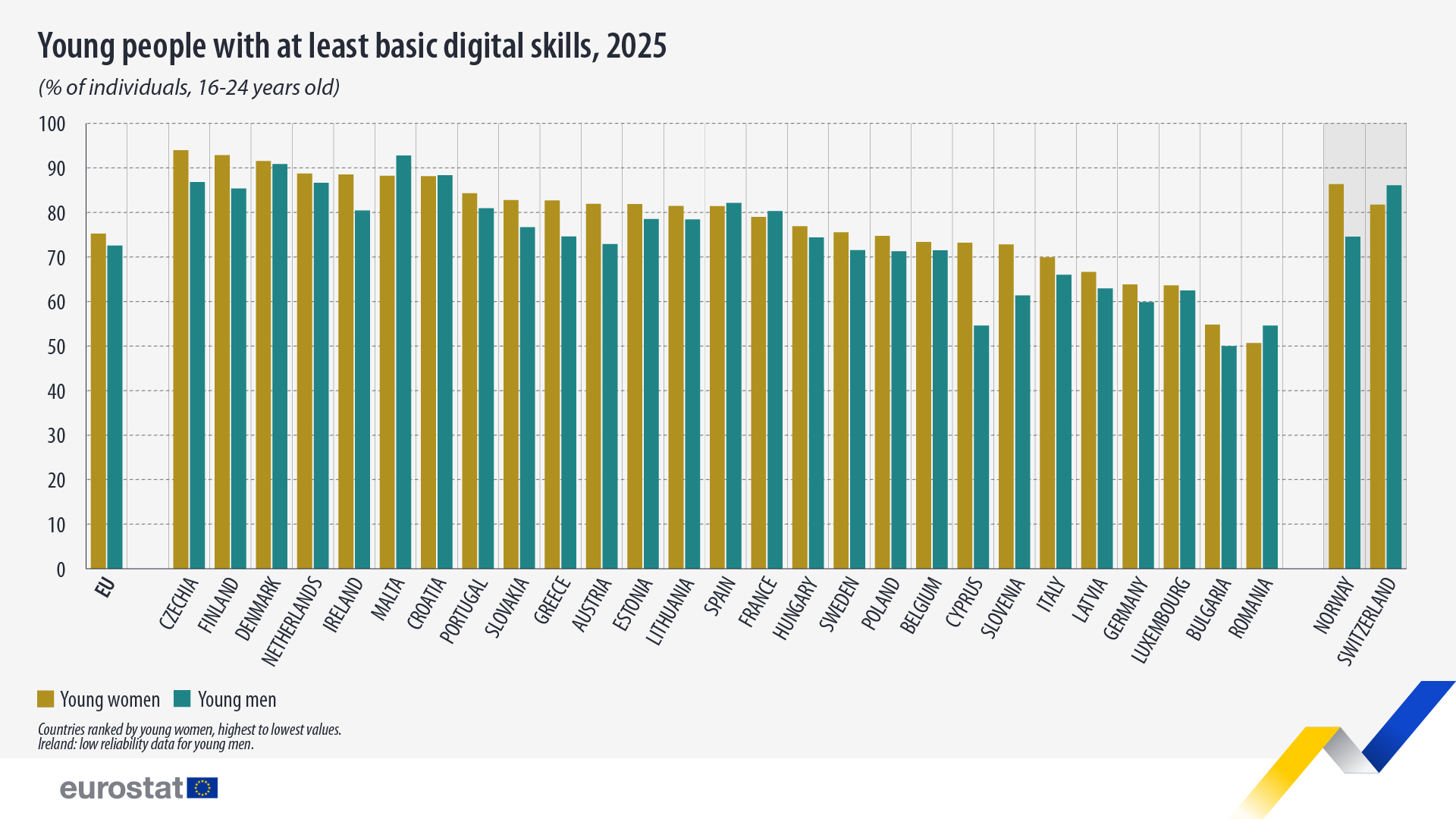
Digital skills are the everyday skills you need to use phones, computers and the internet, from finding information and sending messages to editing files, shopping online and keeping your data safe. In the EU, 60.4% of adults aged 16 to 74 had at least basic digital skills in 2025, according to Eurostat. Among young people aged 16 to 24 the share was 74.6%.
The infographic by Eurostat compares young women and young men in every EU country, plus Norway and Switzerland. The figures below come from the same Eurostat survey of households and individuals.
What are digital skills?
Digital skills are the abilities you use to find, create, share and protect information with digital devices and software. They run from basic tasks such as sending an email or video call to above basic ones such as using spreadsheet formulas or writing code.
Europe measures them with the European Digital Competence Framework, known as DigComp. The European Commission’s Joint Research Centre first published it in 2013, and the current DigComp 3.0 is the fifth version. The JRC says 92% of EU workers reported needing digital skills to do their jobs in 2024 to 2025.
In the UK the Department for Education uses its own essential digital skills framework, which covers the same ground in slightly different groups (more on that further down).
What are the 5 basic digital skills?
The five areas of digital skills in the EU framework are information and data literacy, communication and collaboration, digital content creation, safety, and problem solving. Eurostat counts someone as having at least basic digital skills when they have done at least one activity in each of the five areas.
The activities Eurostat counts in its Digital Skills Indicator 2.0 are everyday ones.
- Information and data literacy covers finding information about goods or services, looking up health information, reading news online and checking whether online information is true.
- Communication and collaboration covers email, internet calls and video calls, instant messaging, social networks and taking part in online consultations or votes.
- Digital content creation covers word processing, spreadsheets, editing photos, video or audio, copying files between folders or devices, building files with text, images and charts, and writing code.
- Safety covers checking a website is secure before giving personal data, reading privacy statements, limiting location access or who sees your social media profile, refusing personal data for advertising and limiting cookies.
- Problem solving covers installing apps, changing settings on software or devices, buying or selling online, online learning, internet banking and job searching online.
People who did more of these activities in all five areas are counted as having above basic skills. In 2025, 31.4% of EU adults and 43.1% of 16 to 24 year olds had above basic skills in every area, Eurostat’s data shows.
How many people have basic digital skills in Europe?
Six in ten adults in the EU have at least basic digital skills. Eurostat puts the share at 60.4% of people aged 16 to 74 in 2025, up from 55.6% in 2023 and 53.9% in 2021.
The rest are spread across lower levels. 2.5% of adults had no digital skills at all on Eurostat’s measure, and a further 6.2% could not be assessed because they had not used the internet in the previous three months. The largest group below the basic line was people with low skills, meaning they reached the basic level in four of the five areas (17.4% of adults).
Four EU countries already have more than 80% of adults at the basic level or above. They are the Netherlands (83.6%), Ireland (82.8%), Denmark (81.5%) and Finland (81.0%). Romania (31.8%) and Bulgaria (38.3%) have the lowest shares.
Digital skills of young people by country
Denmark has the highest share of young people with at least basic digital skills, at 92.1% of 16 to 24 year olds in 2025. Czechia (91.7%) and Malta (91.5%) follow. Only two EU countries were below 60%, Bulgaria (52.8%) and Romania (53.3%), as Eurostat reported in July 2026.
The table shows the share of young people aged 16 to 24 with at least basic digital skills in each country, split by sex, with all adults aged 16 to 74 for comparison. Countries are ranked by the young people total.
| Country | Young people | Young women | Young men | All adults |
|---|---|---|---|---|
| EU | 74.6% | 75.9% | 73.3% | 60.4% |
| Denmark | 92.1% | 92.4% | 91.7% | 81.5% |
| Czechia | 91.7% | 94.8% | 87.6% | 70.5% |
| Malta | 91.5% | 89.1% | 93.6% | 66.8% |
| Finland | 89.9% | 93.8% | 86.2% | 81.0% |
| Croatia | 89.1% | 89.0% | 89.2% | 63.4% |
| Netherlands | 88.5% | 89.6% | 87.5% | 83.6% |
| Ireland | 85.5% | 89.4% | 81.2% (low reliability) | 82.8% |
| Portugal | 83.4% | 85.1% | 81.7% | 59.2% |
| Spain | 82.6% | 82.2% | 82.9% | 66.5% |
| Estonia | 80.9% | 82.7% | 79.3% | 62.5% |
| Lithuania | 80.7% | 82.2% | 79.2% | 53.8% |
| Slovakia | 80.5% | 83.5% | 77.4% | 53.6% |
| France | 80.4% | 79.7% | 81.1% | 65.7% |
| Greece | 79.2% | 83.5% | 75.3% | 51.0% |
| Austria | 78.0% | 82.7% | 73.6% | 69.8% |
| Hungary | 76.3% | 77.6% | 75.1% | 57.3% |
| Sweden | 74.2% | 76.2% | 72.2% | 70.0% |
| Poland | 73.6% | 75.4% | 71.9% | 50.4% |
| Belgium | 73.1% | 74.0% | 72.2% | 61.2% |
| Italy | 68.5% | 70.6% | 66.6% | 54.3% |
| Slovenia | 67.5% | 73.5% | 61.9% | 46.5% |
| Latvia | 65.4% | 67.3% | 63.5% | 48.4% |
| Cyprus | 63.9% | 73.9% | 55.1% | 55.8% |
| Luxembourg | 63.6% | 64.2% | 63.1% | 62.4% |
| Germany | 62.3% | 64.4% | 60.4% | 59.6% |
| Romania | 53.3% | 51.1% | 55.1% | 31.8% |
| Bulgaria | 52.8% | 55.3% | 50.5% | 38.3% |
| Switzerland (not in the EU) | 84.8% | 82.5% | 86.9% | 78.0% |
| Norway (not in the EU) | 81.0% | 87.2% | 75.3% | 79.8% |
Germany stands out among the large economies. 62.3% of its young people had at least basic digital skills in 2025, below Italy (68.5%) and only 2.8 points above German adults as a whole. In Greece the gap between young people and all adults is 28.3 points, the widest in the EU.
The shares have not risen everywhere. Between 2021 and 2025 the share of young people with at least basic skills fell by 14.3 points in Latvia, 9.2 points in Cyprus and 8.5 points in Greece. It rose by 11.0 points in Denmark and by 8.5 points or more in Slovakia, Czechia and Italy. The EU figure went from 71.2% to 74.6%.
Do young women or young men have better digital skills?
Young women in the EU are slightly more likely to have basic digital skills than young men. In 2025, 75.9% of women aged 16 to 24 reached the basic level, compared with 73.3% of men, Eurostat says.
Young women were ahead in 22 EU countries. The largest gaps were in Cyprus (73.9% of young women against 55.1% of young men, 18.8 points), Slovenia (11.6 points) and Austria (9.1 points). Young men were ahead in Malta, Romania, Spain, France and Croatia, with the largest gaps in Malta (4.6 points) and Romania (4.0 points).
Across all adults the pattern reverses. 61.8% of men aged 16 to 74 had at least basic skills in 2025, against 59.0% of women. Women are also under-represented in technology jobs, and the European Commission says only one in six ICT specialists in Europe is a woman.
How do digital skills change with age and education?
Digital skills fall with age. Eurostat’s 2025 figures show about three in four people aged 16 to 34 with at least basic skills, against half of 55 to 64 year olds and a third of 65 to 74 year olds.
| Age group | At least basic, 2025 | At least basic, 2021 |
|---|---|---|
| 16 to 24 | 74.6% | 71.2% |
| 25 to 34 | 74.5% | 68.6% |
| 35 to 44 | 70.1% | 64.3% |
| 45 to 54 | 62.3% | 55.1% |
| 55 to 64 | 50.5% | 42.0% |
| 65 to 74 | 33.0% | 25.5% |
| All adults, 16 to 74 | 60.4% | 53.9% |
Older groups have gained the most since 2021. The share of 55 to 64 year olds with basic skills rose by 8.5 points, while the share for 16 to 24 year olds rose by 3.4 points. Part of the gap is about internet use. 21.0% of 65 to 74 year olds could not be assessed in 2025 because they had not been online in the last three months.
Education makes a bigger difference than sex. Among adults aged 25 to 64, 84.5% of people with tertiary education had at least basic digital skills, against 33.6% of those with low formal education. The gap is smaller for 16 to 24 year olds (87.6% against 67.8%).
Which digital skills do people lack most?
Safety and content creation are the areas where most people fall short. Eurostat’s 2025 data shows 92.1% of EU adults had at least basic communication skills, but only 74.6% had basic safety skills and 70.5% had basic content creation skills.
For young people safety is the weakest area. 98.4% of 16 to 24 year olds had basic communication skills and 96.1% had basic problem solving skills, while 83.8% had basic safety skills. In practice that means about one in six young people had not done any of the privacy checks Eurostat asks about, such as reading a privacy statement, limiting location access or blocking cookies.
Because the basic level needs all five areas, one missing area is enough to fall below it. That explains why 74.6% of young people reach the basic level overall, even though the share is above 83% in every single area.
Is the EU on track for its 2030 digital skills target?
The EU is behind its target. The Digital Decade policy programme aims for 80% of adults to have at least basic digital skills by 2030, and for 20 million ICT specialists to be in work.
At 60.4% in 2025 the EU was 19.6 points short of the 80% target. The share rose by 6.5 points between 2021 and 2025, and at that pace it would still be well short in 2030. An earlier goal in the European skills agenda, 70% of adults with basic digital skills by 2025, was not reached either.
The JRC also notes that 43% of secondary school students in the EU did not reach a basic level of digital skills.
Digital skills in the UK
The UK is not in Eurostat’s 2025 data, so it does not appear in the infographic or the table. England uses the essential digital skills framework, which the Department for Education publishes alongside national standards and qualifications.
The framework starts with foundation skills, such as turning on a device, connecting to Wi-Fi safely and keeping passwords secure. It then sets out five skill areas.
- Communicating
- Handling information and content
- Transacting
- Problem solving
- Being safe and legal online
Each area has skills for life and extra skills for work. The Department for Education published revised essential digital skills standards on 15 July 2026, updated for changes in technology including artificial intelligence. They run from Entry Level 1 to Level 2 and apply to England. Essential Digital Skills qualifications and Digital Functional Skills qualifications remain in place.
How can you improve your digital skills?
A practical place to start is the area you use least. For most adults in Europe that is safety or content creation, going by Eurostat’s figures.
- Check the five areas against what you already do. If you have never changed your privacy settings or limited cookies, that is the gap Eurostat’s data shows most often.
- Use a self-assessment based on DigComp. The JRC lists DigComp-based assessment tools on its framework page.
- In the EU, the Digital Skills and Jobs Platform lists information, training and funding opportunities.
- In England, adults can take Essential Digital Skills qualifications, which are built on the national standards.
About these figures
All country figures come from Eurostat’s survey on ICT usage in households and by individuals, dataset isoc_sk_dskl_i21, last updated on 17 April 2026. The survey covers people aged 16 to 74. It records what people did online or with software, and Eurostat treats those activities as a proxy for skills. It does not test skills directly.
The 2025 figure for young men in Ireland is flagged by Eurostat as low reliability. Ireland has no 2021 figure for young people in the dataset, so it is left out of the change figures. Kosovo and the EU candidate countries are in Eurostat’s dataset but are not shown here.
Percentages are rounded to one decimal place. Points of change, gaps between groups and the distance to the 2030 target are our own calculations from Eurostat’s published data. Eurostat is not responsible for these calculations.
Questions about digital skills
What are basic digital skills?
Basic digital skills are the everyday tasks you need to get by online, such as finding information, sending messages, creating a simple document, protecting your personal data and solving simple problems like installing an app. Eurostat counts someone as having at least basic skills when they have done at least one activity in each of the five areas.
What are some examples of digital skills?
Examples include searching for health information, making video calls, using a spreadsheet, editing a photo, reading a privacy statement before giving personal data, changing app settings, banking online and applying for a job online. Writing code and using spreadsheet formulas count towards above basic skills.
Which country has the best digital skills in Europe?
The Netherlands has the highest share of adults with at least basic digital skills, at 83.6% in 2025. For young people aged 16 to 24, Denmark is first with 92.1%.
Which country has the lowest digital skills in the EU?
Romania has the lowest share of adults with at least basic digital skills, at 31.8% in 2025, followed by Bulgaria at 38.3%. The same two countries are lowest for young people.
What percentage of young people have digital skills?
In the EU, 74.6% of people aged 16 to 24 had at least basic digital skills in 2025 and 43.1% had above basic skills. Only 0.9% had no digital skills at all.
What is the difference between digital skills and digital literacy?
The two terms are often used for the same thing. In the EU framework, information and data literacy is one of the five areas of digital skills, covering how you find, judge and manage information online.
What is the EU target for digital skills?
The EU aims for 80% of adults aged 16 to 74 to have at least basic digital skills by 2030. In 2025 the share was 60.4%.
Sources
- Eurostat, 75% of young Europeans have at least basic digital skills (15 July 2026)
- Eurostat, Individuals’ level of digital skills (from 2021 onwards), isoc_sk_dskl_i21
- Eurostat, Digital skills indicator 2.0 metadata
- European Commission Joint Research Centre, Digital Competence Framework (DigComp)
- European Commission, Digital skills
- European Commission, Digital skills and jobs
- Department for Education, Essential digital skills framework
- Department for Education, Essential digital skills standards 2026