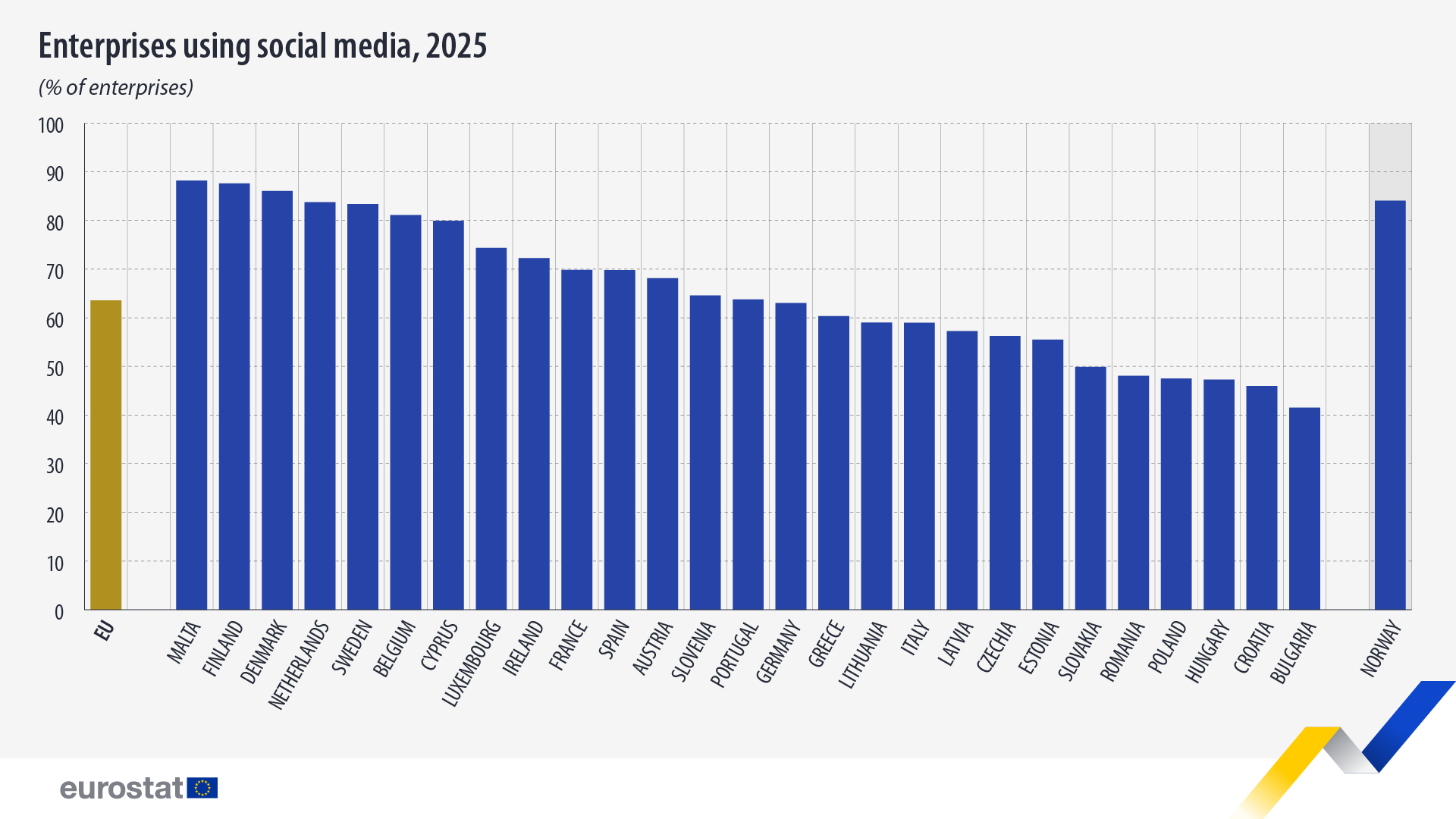
Almost two in three businesses in the EU used social media in 2025. Eurostat’s survey of firms with 10 or more staff puts the share at 63.6%, up from 61.1% in 2023 and 42.5% in 2016. Use varies a lot by country. Nearly nine in ten firms in Malta, Finland and Denmark are on social media, against about four in ten in Bulgaria.
How many businesses use social media?
In 2025, 63.6% of EU enterprises with 10 or more employees used at least one type of social media, Eurostat reports. The EU has about 1.53 million firms of that size, and around 157,000 of them answered the 2025 survey on ICT usage and e-commerce in enterprises, according to Eurostat’s article on social media use by enterprises.
Growth has been steady for more than a decade. Eurostat’s isoc_cismt dataset shows the EU share was 34.2% in 2014, 42.5% in 2016, 50.3% in 2019, 58.7% in 2021 and 61.1% in 2023. That’s a rise of 21.1 percentage points since 2016, but the pace has slowed. Between 2023 and 2025 the share went up by only 2.5 points (our calculation).
As the Eurostat infographic shows, the gap between countries is much bigger than the change over time. The top and bottom countries are more than 46 points apart.
Businesses using social media by country
Malta has the highest share of businesses on social media in the EU, and Bulgaria the lowest. The table gives every EU country, plus Norway and the EU candidate countries that Eurostat covers, with the share of people who use social networks alongside for comparison.
| Country | Businesses, 2025 | Businesses, 2023 | Businesses, 2016 | People, 2025 |
|---|---|---|---|---|
| EU | 63.6% | 61.1% | 42.5% | 67.3% |
| Malta | 88.2% | 87.1% | 71.2% | 82.4% |
| Finland | 87.6% | 81.0% | 59.8% | 81.3% |
| Denmark | 86.1% | 82.5% | 64.0% | 89.7% |
| Netherlands | 83.8% | 83.2% | 64.6% | 81.2% |
| Sweden | 83.3% | 80.3% | 58.3% | 74.7% |
| Belgium | 81.1% | 79.3% | 52.8% | 67.7% |
| Cyprus | 79.9% | 79.9% | 64.4% | 86.5% |
| Luxembourg | 74.4% | 70.0% | 48.9% | 67.3% |
| Ireland | 72.3% | 73.6% | 66.2% | 79.9% |
| France | 69.8% | 66.8% | 36.5% | 70.8% |
| Spain | 69.8% | 63.7% | 43.9% | 69.5% |
| Austria | 68.1% | 69.7% | 49.5% | 67.9% |
| Slovenia | 64.6% | 56.8% | 46.0% | 65.4% |
| Portugal | 63.8% | 61.1% | 44.5% | 70.5% |
| Germany | 63.0% | 60.7% | 47.2% | 59.2% |
| Greece | 60.3% | 60.8% | 44.1% | 73.0% |
| Lithuania | 59.0% | 56.6% | 44.5% | 70.3% |
| Italy | 59.0% | 57.3% | 39.2% | 56.4% |
| Latvia | 57.3% | 55.3% | 26.1% | 79.3% |
| Czechia | 56.3% | 52.7% | 34.0% | 70.1% |
| Estonia | 55.5% | 54.3% | 38.5% | 72.6% |
| Slovakia | 49.9% | 46.8% | 34.3% | 61.9% |
| Romania | 48.1% | 40.5% | 30.0% | 79.6% |
| Poland | 47.5% | 47.6% | 25.3% | 63.3% |
| Hungary | 47.3% | 47.8% | 34.4% | 78.7% |
| Croatia | 46.0% | 50.9% | 41.5% | 61.5% |
| Bulgaria | 41.5% | 38.0% | 31.7% | 71.1% |
| Albania (candidate country) | 86.0% | no data | no data | 74.7% |
| Norway (not in the EU) | 84.1% | 82.9% | 68.3% | 88.9% |
| Montenegro (candidate country) | 75.2% | 61.0% | 49.6% | 83.8% |
| Bosnia and Herzegovina (candidate country) | 66.8% | 60.5% | no data | 66.5% |
| Serbia (candidate country) | 56.8% | 54.6% | no data | 76.3% |
| Türkiye (candidate country) | 55.1% | 40.2% | 38.1% | 80.4% |
Business figures are the share of enterprises with 10 or more employees that use social media (Eurostat isoc_cismt). People figures are the share of everyone aged 16 to 74 who took part in social networks in the 3 months before the survey, such as posting or creating a profile (Eurostat isoc_ci_ac_i). The UK isn’t included because it left the EU in 2020 and no longer reports to Eurostat.
Which countries’ businesses use social media most?
Malta leads with 88.2% of businesses on social media in 2025, followed by Finland (87.6%) and Denmark (86.1%), according to Eurostat. The Netherlands (83.8%), Sweden (83.3%), Belgium (81.1%) and Cyprus (79.9%) come next. Outside the EU, Albania (86.0%) and Norway (84.1%) are just as high.
Some of the biggest gains came from countries that started low. Eurostat says France gained 33.4 points between 2016 and 2025, from 36.5% to 69.8%, and Latvia gained 31.1 points, from 26.1% to 57.3%. Finland’s share almost doubled, from 45.8% in 2014 to 87.6% in 2025.
Where do businesses use social media least?
Bulgaria has the lowest share in the EU, with 41.5% of businesses using social media in 2025. Croatia (46.0%), Hungary (47.3%), Poland (47.5%), Romania (48.1%) and Slovakia (49.9%) are the other EU countries where fewer than half of firms use it.
Croatia is the only country where use fell sharply between 2023 and 2025, from 50.9% to 46.0%. Ireland, an early adopter at 66.2% in 2016, grew by only 6.1 points to 72.3%, the second smallest rise in the EU after Croatia, according to Eurostat.
Low business use doesn’t mean people in those countries avoid social media. In Romania 79.6% of people aged 16 to 74 use social networks and in Hungary 78.7%, well above the EU average of 67.3%. Germany and Italy show the opposite pattern. They have the lowest shares of people on social networks in the EU (59.2% and 56.4%), yet Germany’s business use (63.0%) matches the EU average and Italy’s (59.0%) is only a little below it.
Do bigger companies use social media more?
Large firms are far more likely to use social media than small ones. Eurostat found that 89.1% of large enterprises (250 or more people) used social media in 2025, against 76.2% of medium firms (50 to 249 people) and 60.6% of small firms (10 to 49 people).
All three sizes have grown at a similar rate. In 2016 the shares were 66.0% for large firms, 50.8% for medium firms and 40.3% for small firms. Because small firms make up about 83% of the businesses surveyed, they pull the EU average down close to their own figure. Eurostat’s survey doesn’t cover businesses with fewer than 10 people, so it says nothing about sole traders or micro businesses.
Which industries use social media most?
Media businesses are the heaviest users. In 2025, 89.8% of EU firms in publishing, film, video, TV, sound recording and broadcasting used social media, according to Eurostat’s isoc_cismtn2 dataset. Hotels and other accommodation (86.9%) and travel agencies and tour operators (86.8%) come next, followed by the information and communication sector as a whole (83.2%).
Firms that sell to the public or rely on bookings tend to use social media more. Retailers came in at 69.7% and accommodation and food services at 78.3%. The lowest shares were in transport and storage (44.6%), textiles and clothing manufacturing (47.6%) and construction (50.0%).
Why do businesses use social media?
Most businesses use social media for marketing. In Eurostat’s 2023 survey, which asked about purposes, 84.2% of EU firms on social media used it to build their image or market their products. That’s 50.7% of all firms with 10 or more staff, up from 42.6% in 2019, according to the isoc_cismp dataset.
The other uses Eurostat measured, as a share of businesses that use social media, were
- recruiting staff, 60.1%
- getting or answering customer opinions, reviews and questions, 50.7%
- working with business partners, suppliers or public bodies, 27.9%
- sharing views and knowledge inside the business, 24.3%
- involving customers in developing or improving products, 22.0%
Recruitment has grown fastest. The share of all firms using social media to hire went from 27.4% in 2019 to 36.2% in 2023. Large firms rely on it most, with 70.3% of large enterprises recruiting through social media in 2023, against 31.9% of small ones.
Which types of social media do businesses use?
Social networks are by far the most common type. Eurostat’s 2023 figures show 59.0% of EU firms used social networks such as Facebook or LinkedIn, 31.5% used multimedia sharing sites such as YouTube and 10.3% had a blog or microblog. Wikis for sharing knowledge were used by 5.6% in 2021, the last year that type was reported.
About half of the businesses on social media use more than one type (our calculation). In 2023, 31.6% of all firms used two or more types and 29.6% used just one, Eurostat says.
How many businesses pay to advertise online?
About a third. In 2024, 32.6% of EU businesses with 10 or more staff paid to advertise on the internet, and 27.4% paid for targeted adverts based on page content, search keywords, people’s past activity or their location, according to Eurostat. Malta had the highest share at 60.4%, then Finland (49.8%) and Cyprus (49.4%). Romania (22.8%) and Poland (23.2%) had the lowest shares among the EU countries with figures.
Paying for adverts is much less common than simply being on social media. The share of firms using social media in 2025 was almost twice the share paying for online adverts in 2024 (our calculation).
How many people use social media in Europe?
In 2025, 67.3% of people in the EU aged 16 to 74 took part in social networks, up from 59.3% in 2023, Eurostat’s survey of internet use by individuals shows. Use is almost universal among young people, at 90.5% of those aged 16 to 24 and 85.5% of those aged 25 to 34. It drops to 34.1% among people aged 65 to 74.
Denmark has the highest share in the EU at 89.7%, followed by Cyprus (86.5%) and Malta (82.4%). Italy (56.4%) and Germany (59.2%) have the lowest.
About these figures
Eurostat’s business figures come from the EU survey on ICT usage and e-commerce in enterprises, run by national statistics offices early in the survey year. It covers firms with at least 10 employees and self-employed people in manufacturing, energy and water, construction, trade, transport, hotels and restaurants, information and communication, real estate, professional and administrative services and computer repair. Banks, insurers, farms and mines are left out.
Eurostat counts social media as social networks, blogs and microblogs, multimedia sharing sites and wikis. Its figures don’t break use down by individual platform. For 2025 Eurostat has published only the overall share of firms using social media, so the most recent figures on types and purposes are from 2023. Sweden and France have a break in their 2023 series.
Questions about businesses using social media
What percentage of businesses use social media?
In the EU, 63.6% of businesses with 10 or more employees used social media in 2025, according to Eurostat. The share is 89.1% for large firms and 60.6% for small firms.
How can using social media help a business?
Businesses mostly use it to build their image and market products, which 84.2% of EU firms on social media did in 2023. Many also use it to recruit staff (60.1%) and to get or reply to customer reviews and questions (50.7%), Eurostat found.
What social media is good for business?
Social networks such as Facebook and LinkedIn are the type most businesses use, at 59.0% of EU firms in 2023. Video and image sharing sites such as YouTube come second at 31.5%. Eurostat doesn’t rank individual platforms.
Do small businesses use social media?
Most do. Eurostat found that 60.6% of EU businesses with 10 to 49 employees used social media in 2025, up from 40.3% in 2016. The survey doesn’t cover firms with fewer than 10 people.
Which country uses social media the most for business?
Malta, where 88.2% of businesses used social media in 2025. Finland (87.6%) and Denmark (86.1%) are close behind, according to Eurostat.
Sources
- Eurostat, Two-thirds of EU enterprises use social media, news article, 12 June 2026, which carries the infographic
- Eurostat, Social media, statistics on the use by enterprises, Statistics Explained, data extracted June 2026
- Eurostat, Social media use by type, internet advertising and size class of enterprise (isoc_cismt), updated 27 February 2026
- Eurostat, Social media use by type, internet advertising and NACE Rev.2 activity (isoc_cismtn2), updated 27 February 2026
- Eurostat, Social media use by purpose and size class of enterprise (isoc_cismp), updated 17 July 2025
- Eurostat, Individuals, internet activities (isoc_ci_ac_i), updated 17 April 2026
Eurostat material is reused under the Creative Commons Attribution 4.0 licence set out in Eurostat’s copyright notice. The infographic is shown unchanged. Figures marked as our calculation were worked out by us from Eurostat data, and Eurostat is not responsible for them.