What prejudice means
The American Psychological Association defines prejudice as a negative attitude towards a person or group formed before any experience of them [1]. It has a feeling side, such as anger, contempt, nervousness or pity, and a thinking side, made up of assumptions and stereotypes about the group [1]. The word comes from the Latin praeiudicium, from prae (before) and iudicium (judgement), and has been used in English since around 1300 [2]. In its older, broader sense it can mean any judgement made in advance, favourable or not [1].
Prejudice is usually aimed at a group someone belongs to, or is thought to belong to, rather than at the person themselves. It tends to resist change, because it shapes how people take in information about the group they are prejudiced against [1].
Types of prejudice
Most kinds of prejudice have their own name. The APA lists these [1]:
- Racism: prejudice based on race or ethnic group.
- Sexism: prejudice based on sex or gender. The APA includes transphobia here, although it is often listed separately.
- Homophobia and biphobia: prejudice based on sexual orientation.
- Ageism: prejudice based on age.
- Ableism: prejudice against disabled people.
Religious prejudice is usually named by the faith it targets, such as antisemitism (against Jewish people) and Islamophobia (against Muslims). People can also be prejudiced over class, accent, nationality, weight and many other traits [2].
Prejudice, stereotypes and discrimination
These three words are often used as if they mean the same thing, but they describe different stages:
| Term | What it is | Example |
|---|---|---|
| Stereotype | A belief about what members of a group are like | Assuming older people can’t use technology |
| Prejudice | A feeling or attitude towards a group, usually negative | Disliking or distrusting older colleagues |
| Discrimination | Treating someone unfairly because of their group | Not interviewing an applicant because of their age |
The APA notes that prejudice usually shows itself through discrimination [1]. The difference matters in law. Prejudiced views are not illegal in themselves, but in the UK the Equality Act 2010 makes it unlawful to discriminate against someone because of their age, disability, gender reassignment, marriage or civil partnership, pregnancy or maternity, race, religion or belief, sex or sexual orientation, at work, in education, as a consumer and in housing [3]. In the US, federal civil rights law covers similar ground.
How often the news talks about prejudice
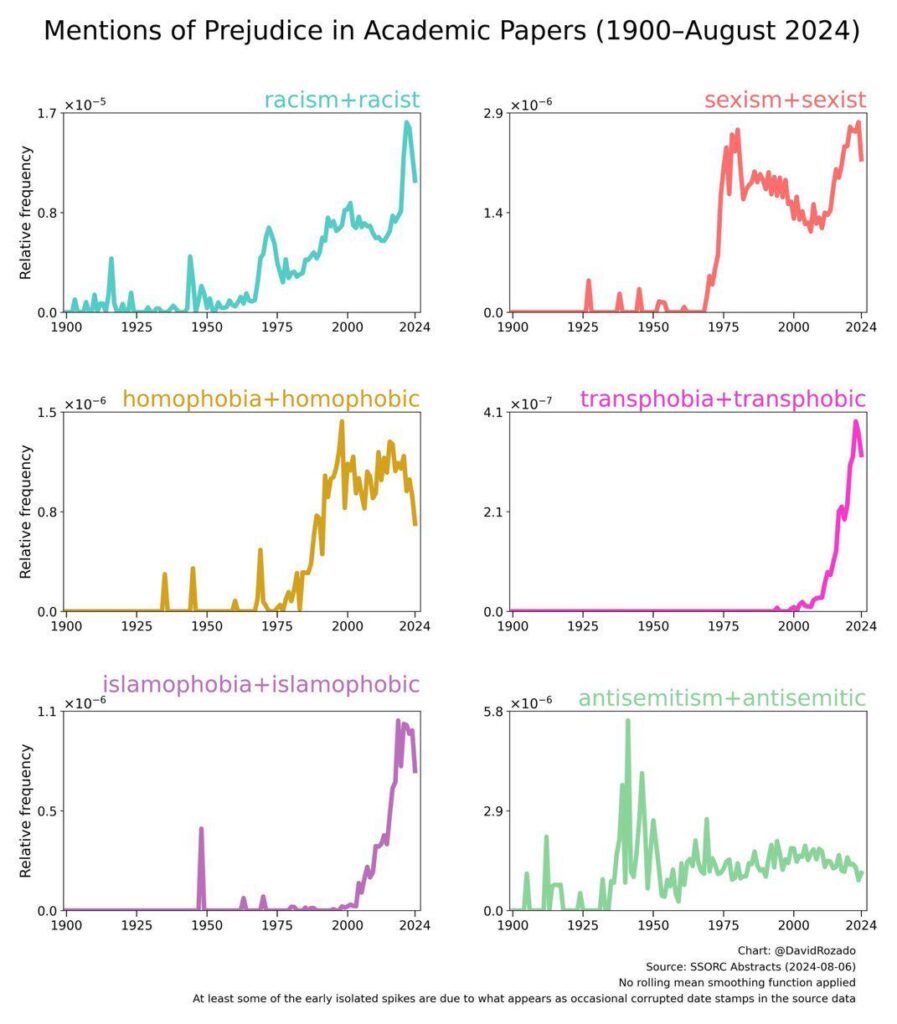
One way researchers have studied prejudice in public life is by counting how often newspapers use words for it. David Rozado, Musa al-Gharbi and Jamin Halberstadt analysed 27 million news and opinion articles published between 1970 and 2019 by 47 of the most popular US news outlets [4]. They measured each word’s yearly frequency as a share of all words published, so changes in the amount each outlet wrote don’t distort the results [4].
They found a sharp rise in words such as racism, sexism, homophobia, transphobia and Islamophobia during the 2010s, in left and right leaning outlets alike [4][5]. Between 2010 and 2019 the word “racist” rose 638% in the New York Times and 514% in the Washington Post, and “sexist” rose 403% and 141% [4]. Racism has always been the most written about form of prejudice, followed by antisemitism, sexism and homophobia [4].
Rozado’s infographic on this page extends four of the newspapers to 2020. Between 2010 and 2020, use of racism, racist and racists rose by 712% in the New York Times, 361% in the Washington Post, 756% in the Los Angeles Times and 468% in the Wall Street Journal. Antisemitism terms rose by between 71% and 87% across the four papers. Transphobia terms rose by 8,922% in the New York Times, a huge figure that reflects how rarely the word was used in 2010, not how common it became. Over the same decade, homophobia terms fell 6% in the Washington Post and Islamophobia terms fell 38% in the Wall Street Journal.
The researchers found that by 2014, before Donald Trump’s first presidential campaign, words for racism, homophobia, transphobia and sexism were already at or near their highest levels [4]. Their follow-up, which tracked the words to June 2021, found no clear drop after he left office [5].
These counts measure how much the media talks about prejudice, not how much prejudice there is. Rozado and his co-authors point out that over the same period polls showed Americans, including Republican voters, becoming warmer towards Black, Hispanic, immigrant and Muslim people and more accepting of same sex marriage [5].
Where prejudice comes from
The psychologist Gordon Allport argued in The Nature of Prejudice (1954) that prejudice grows out of normal thinking. People sort the world into categories to make sense of it, and those categories become the basis for prejudging others [2]. Social psychologists also point to competition between groups for jobs, status or resources, to the attitudes people pick up from family and community, and to a strong tendency to favour your own group over others.
Because it builds on ordinary habits of thought, most people hold some prejudices without being aware of them. That is why many organisations now train staff to notice unconscious or implicit bias, alongside rules against discrimination.
How to reduce prejudice
The best supported approach is contact. Allport’s contact hypothesis says prejudice falls when people from different groups spend time together on equal terms, working towards shared goals, with support from those in charge [2]. Thomas Pettigrew and Linda Tropp tested this in a meta-analysis of 515 studies covering a quarter of a million people in 38 countries. They found that contact reduces prejudice mainly by lowering anxiety about the other group and by increasing empathy, and to a lesser extent by increasing knowledge [2].
For your own prejudices, the practical steps follow from that research:
- Spend time with people from groups you don’t usually mix with, ideally on a shared task.
- Notice when you are judging someone by their group rather than what they have actually done.
- Try to see a situation from the other person’s side.
- Question stereotypes when you hear them, including in jokes and the media.
Other research has found that people are more likely to challenge discrimination when they see a benefit in doing so and less likely when worried about others’ reactions [2], so workplace and school rules that back people up when they speak out make a real difference.
Questions about prejudice
What is prejudice in simple words?
Judging a person or group before you know them, usually negatively, based on the group they belong to [1].
What are some examples of prejudice and discrimination?
Believing that a particular nationality is lazy is prejudice. Refusing to rent a flat to someone of that nationality is discrimination, and in the UK it is unlawful under the Equality Act 2010 [3].
What is the difference between prejudice and discrimination?
Prejudice is an attitude or feeling. Discrimination is an action: treating someone worse because of their group [1].
How can you reduce your own prejudice?
Regular contact with people from other groups on equal terms is the method with the strongest evidence. It works mainly by reducing anxiety and increasing empathy [2].
Has prejudice increased in the news?
Words for prejudice have. Use of racism, racist and racists in four major US newspapers rose by between 361% and 756% from 2010 to 2020 [4]. That shows how much the media discusses prejudice, not whether prejudice itself has grown [5].
Sources
- American Psychological Association, APA Dictionary of Psychology: prejudice, updated 15 November 2023.
- Wikipedia, Prejudice (word origin, Allport, contact hypothesis, Pettigrew and Tropp meta-analysis).
- GOV.UK, Discrimination: your rights.
- David Rozado, Prevalence of Prejudice-Denoting Words in News Media Discourse, 19 July 2021 (summary of the paper by Rozado, al-Gharbi and Halberstadt in Social Science Computer Review).
- David Rozado, Musa al-Gharbi and Jamin Halberstadt, The ‘Great Awokening’ Preceded Trump. It May Continue Beyond Him, 8 September 2021.
Last reviewed 7 November 2026