How big is the global economy?
The global economy was worth $118.5 trillion in 2025 and is projected to reach $128.0 trillion in 2026, on the IMF’s October 2026 figures. The United States ($30.9 trillion) and China ($19.6 trillion) made up about 43% of the 2025 total. This global economy infographic by Visual Capitalist, made from IMF projections in late 2024, put 2025 at $115 trillion.
All the figures here are nominal GDP in current US dollars, the measure the infographic uses [1][2]. Visual Capitalist sized each country by its share of the world economy and grouped them by region, which makes the scale of the two largest economies obvious at a glance [1]. The sections below give the latest figures by country and region, and where the 2025 projections turned out wrong.
The largest economies in the world
The table shows the 15 largest economies by GDP on the IMF’s October 2026 World Economic Outlook, with the infographic’s projection for 2025 alongside. Values are in trillions of US dollars [1][2].
| Rank 2025 | Country | Infographic, projected 2025 | IMF, 2025 | IMF, projected 2026 |
|---|---|---|---|---|
| 1 | United States | 30.3 | 30.86 | 32.64 |
| 2 | China | 19.5 | 19.63 | 21.55 |
| 3 | Germany | 4.9 | 5.12 | 5.47 |
| 4 | Japan | 4.4 | 4.45 | 4.34 |
| 5 | United Kingdom | 3.7 | 4.01 | 4.27 |
| 6 | India | 4.3 | 3.91 | 4.06 |
| 7 | France | 3.3 | 3.38 | 3.55 |
| 8 | Russia | 2.2 | 2.57 | 2.86 |
| 9 | Italy | 2.5 | 2.55 | 2.70 |
| 10 | Canada | 2.3 | 2.32 | 2.49 |
| 11 | Brazil | 2.3 | 2.28 | 2.65 |
| 12 | Spain | 1.8 | 1.91 | 2.09 |
| 13 | South Korea | 1.9 | 1.88 | 2.25 |
| 14 | Australia | 1.9 | 1.84 | 2.11 |
| 15 | Mexico | 1.8 | 1.84 | 2.18 |
Türkiye ($1.60 trillion), Indonesia ($1.45 trillion), the Netherlands ($1.32 trillion), Saudi Arabia ($1.27 trillion) and Switzerland ($1.06 trillion) complete the top 20 for 2025 [2]. World Bank figures for 2025 are close to the IMF’s, at $118.35 trillion for the world, $30.77 trillion for the US and $19.50 trillion for China [3].
Where the 2025 projections went wrong
Most of the infographic’s projections were close, but a few were not. The biggest miss in the top ten was India. Visual Capitalist showed India at $4.3 trillion, comfortably ahead of the UK at $3.7 trillion [1]. In the IMF’s latest figures India’s 2025 GDP was $3.91 trillion and the UK’s was $4.01 trillion, so the UK was fifth and India sixth [2]. Russia also came in well above its projection, at $2.57 trillion rather than $2.2 trillion.
The post that goes with the infographic said India was projected to pass Japan for fourth place in 2026 [1]. That no longer looks likely. On the October 2026 projections India’s GDP for 2026 is $4.06 trillion, behind Japan ($4.34 trillion) and the UK ($4.27 trillion) [2]. A weaker rupee explains part of the gap. It averaged 87.2 to the dollar in 2025, against 83.7 in 2024, on World Bank figures [3]. In real terms India is still the fastest growing of the large economies.
Germany’s position is unchanged. It overtook Japan as the third largest economy in 2024, as the infographic’s post noted, and stayed there in 2025 [1][2].
The world economy by region
Advanced economies produce most of the world’s output in dollar terms. On the IMF’s figures they account for about 58% of world GDP in 2026, and emerging and developing economies for about 42% (our arithmetic) [2]. The European Union’s combined GDP is $21.3 trillion in 2025 and a projected $22.8 trillion in 2026, larger than China’s [2].
Africa is small in dollar terms. The IMF puts the GDP of the whole continent at $3.16 trillion in 2025, less than Germany’s alone, and $3.65 trillion in 2026 [2]. South Africa, Egypt and Nigeria are among its largest economies, at $427 billion, $365 billion and $290 billion in 2025 [2].
World economic growth in 2025 and 2026
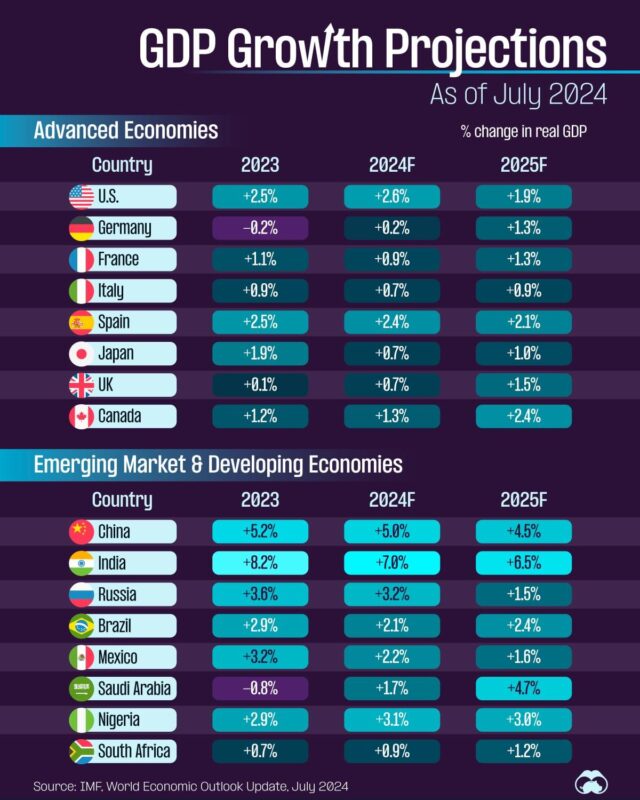
Real GDP growth, which strips out inflation, gives a different picture from the dollar totals. The IMF estimates world growth at 3.5% in 2025 and projects 3.1% for 2026 [4]. Advanced economies grew by about 2.0% in 2025, against 4.5% for emerging and developing economies [4].
| Economy | Real growth 2025 | Projected 2026 |
|---|---|---|
| World | 3.5% | 3.1% |
| India | 7.8% | 7.0% |
| China | 5.0% | 4.5% |
| Indonesia | 5.1% | 5.1% |
| United States | 2.3% | 2.3% |
| United Kingdom | 1.2% | 1.3% |
| Japan | 1.2% | 0.7% |
| Germany | 0.2% | 1.3% |
Figures are from the IMF World Economic Outlook, October 2026 [4]. Growth of the dollar totals can be much faster or slower than real growth, because they also move with inflation and exchange rates.
Nominal GDP and purchasing power
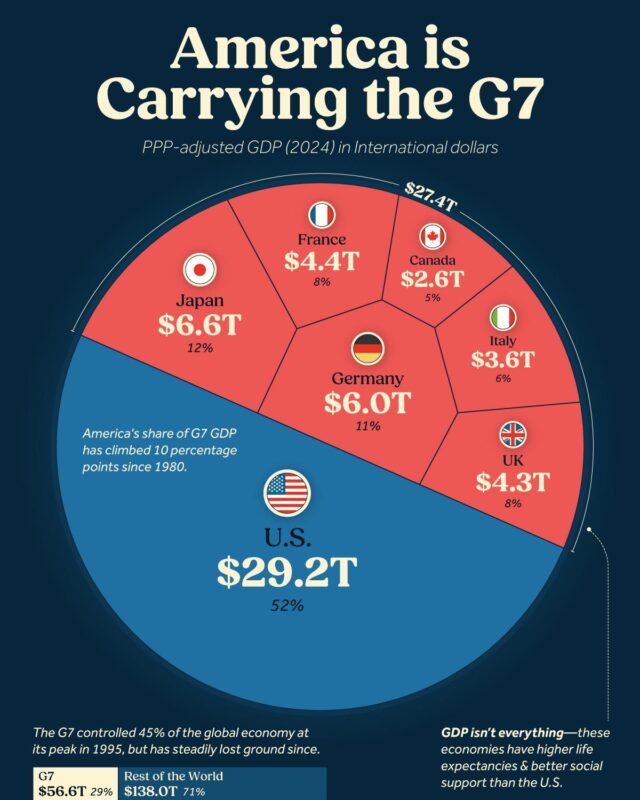
Nominal GDP converts each country’s output into dollars at market exchange rates. It is the right measure for comparing the size of economies in world markets, but it understates output in countries where prices are low. On a purchasing power parity basis, which adjusts for that, China is the largest economy, with 19.9% of world GDP in 2026 against 14.6% for the United States, and India is third at 8.6% [5].
Questions about the global economy
What is the total world GDP?
The IMF puts world GDP at $118.5 trillion in 2025 and projects $128.0 trillion for 2026, in current US dollars [2]. The World Bank’s figure for 2025 is $118.35 trillion [3].
What are the top 5 economies in the world?
In 2025 they were the United States, China, Germany, Japan and the United Kingdom, on IMF figures [2]. India was sixth.
What share of the world economy is the US?
About 26% in 2025, at $30.86 trillion out of $118.5 trillion, with China at about 17% (our arithmetic from IMF figures) [2].
Is India’s economy bigger than Japan’s?
Not in dollar terms. India’s GDP was $3.91 trillion in 2025 against Japan’s $4.45 trillion, and the IMF projects India still behind Japan in 2026 [2].
How fast is the world economy growing?
The IMF estimates real world growth at 3.5% in 2025 and projects 3.1% in 2026 [4].
Sources
- Visual Capitalist on Voronoi, How the World Economy Will Look in 2025 (12 December 2024). The creator’s post with this infographic, IMF projections.
- International Monetary Fund, GDP, current prices, World Economic Outlook (October 2026).
- World Bank, GDP (current US$), and official exchange rate (rupees per US dollar, period average).
- International Monetary Fund, Real GDP growth, World Economic Outlook (October 2026).
- International Monetary Fund, GDP based on PPP, share of world, World Economic Outlook (October 2026).
Last reviewed 11 November 2026