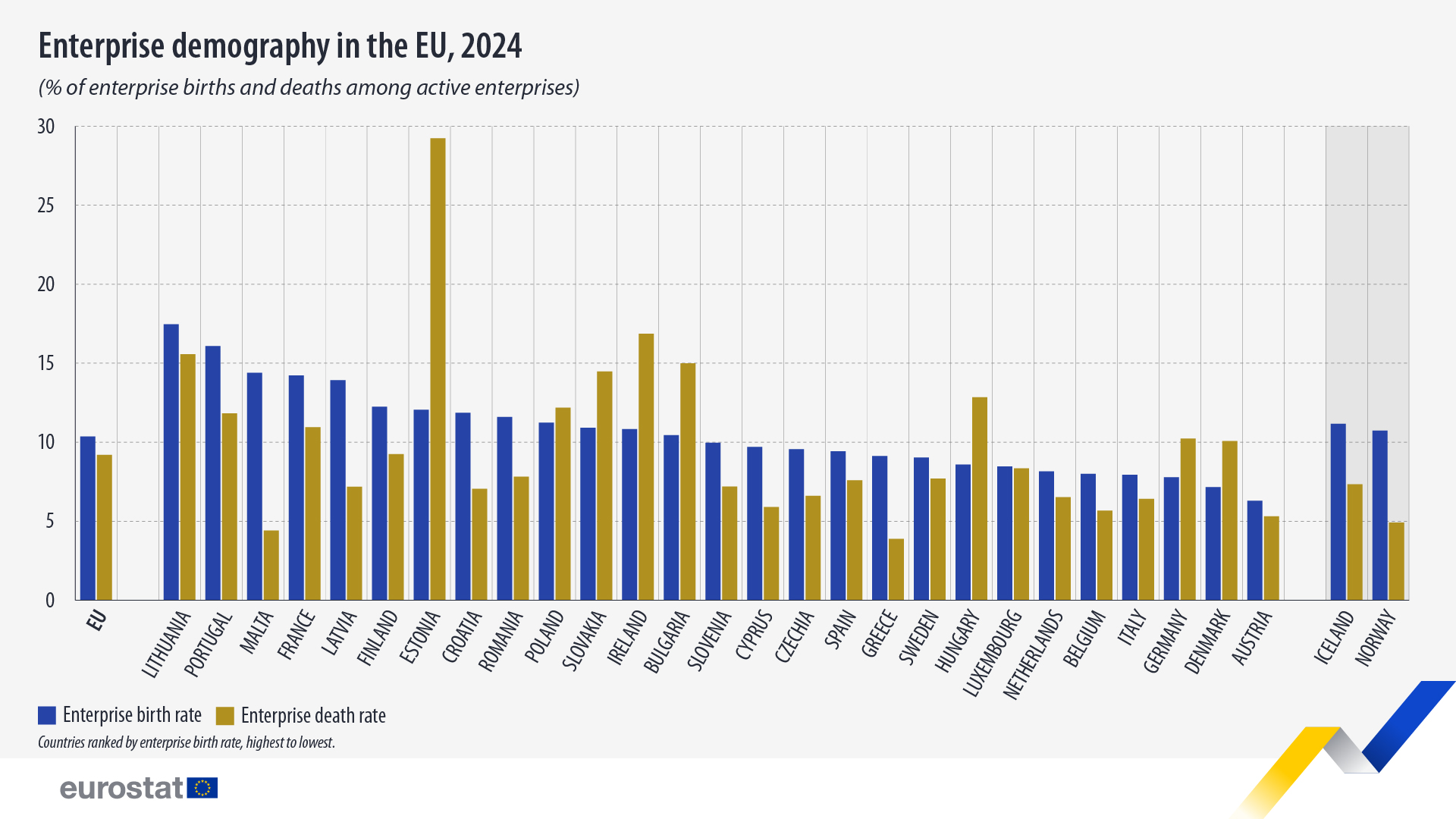
About one in ten businesses in the EU is brand new each year, and almost as many close. In 2024 the enterprise birth rate was 10.4% and the provisional death rate was 9.2%, Eurostat reports. That means about 3.5 million new businesses started and about 3.1 million closed, out of 34.2 million active. Roughly one in five new businesses closes within its first year.
How many businesses start and close in Europe each year?
In 2024, 3,541,482 enterprises were born in the EU and 3,143,782 died, against a population of 34,188,564 active enterprises, according to Eurostat’s business demography data (bd_size). The death count for 2024 is provisional, because Eurostat only confirms a death once the business has not come back to life within two years.
More businesses opened than closed, so the number of active enterprises in the EU grew by 2.6% in 2024. The same Eurostat article says the 3.5 million new enterprises created about 3.7 million jobs in their first year. That is about one job per new business (our calculation), because most new firms start very small.
The final figures for 2023 give a firmer picture. That year the EU birth rate was 10.5% and the death rate was 8.1%, so the gap between openings and closures was wider than the provisional 2024 figures suggest.
Business birth and death rates by country
Birth rates in 2024 ranged from 6.3% in Austria to 17.5% in Lithuania, and death rates ran from 3.9% in Greece to 29.2% in Estonia. As the Eurostat infographic shows, there is no simple pattern where high birth rates come with low death rates. Lithuania and Portugal have some of the highest rates of both, which points to a lot of churn rather than fast growth.
The table below lists every EU country plus Iceland and Norway, ranked by birth rate in the same order as the infographic. The survival columns show the share of businesses born one year and three years earlier that were still active in 2024.
| Country | Birth rate | Death rate | Still active after 1 year | Still active after 3 years |
|---|---|---|---|---|
| EU | 10.4% | 9.2% | 80.5% | 57.2% |
| Lithuania | 17.5% | 15.6% | 67.5% | 43.5% |
| Portugal | 16.1% | 11.8% | 74.0% | 47.7% |
| Malta | 14.4% | 4.4% | 80.9% | 50.4% |
| France | 14.2% | 10.9% | 78.3% | 48.9% |
| Latvia | 13.9% | 7.2% | 74.5% | 50.1% |
| Finland | 12.2% | 9.2% | 84.0% | 66.3% |
| Estonia | 12.1% | 29.2% | 72.8% | 62.6% |
| Croatia | 11.9% | 7.0% | 85.4% | 67.0% |
| Romania | 11.6% | 7.8% | 77.8% | 59.1% |
| Poland | 11.2% | 12.2% | 82.1% | 58.0% |
| Slovakia | 10.9% | 14.5% | 84.8% | 64.3% |
| Ireland | 10.8% | 16.9% | 78.7% | 52.7% |
| Bulgaria | 10.4% | 15.0% | 80.0% | 61.6% |
| Slovenia | 10.0% | 7.2% | 86.5% | 62.9% |
| Cyprus | 9.7% | 5.9% | 88.6% | 63.0% |
| Czechia | 9.6% | 6.6% | 83.6% | 64.0% |
| Spain | 9.4% | 7.6% | 78.6% | 53.6% |
| Greece | 9.1% | 3.9% | 83.3% | 72.5% |
| Sweden | 9.0% | 7.7% | 76.3% | 58.9% |
| Hungary | 8.6% | 12.8% | 83.1% | 49.1% |
| Luxembourg | 8.5% | 8.3% | 87.1% | 70.7% |
| Netherlands | 8.2% | 6.5% | 95.9% | 78.1% |
| Belgium | 8.0% | 5.7% | 89.7% | 74.9% |
| Italy | 7.9% | 6.4% | 81.3% | 61.2% |
| Germany | 7.8% | 10.2% | 77.2% | 57.8% |
| Denmark | 7.2% | 10.1% | 72.6% | 45.4% |
| Austria | 6.3% | 5.3% | 92.3% | 61.2% |
| Iceland (not in the EU) | 11.2% | 7.3% | 75.2% | 48.2% |
| Norway (not in the EU) | 10.8% | 7.2% | 79.9% | 56.3% |
Death rates for 2024 are provisional for every country and some are Eurostat estimates. Germany’s 2024 figures carry a break in series, so they are not fully comparable with earlier years. Survival rates refer to businesses born in 2023 (one year) and 2021 (three years). Source is Eurostat bd_size, updated 23 October 2026.
Which countries have the highest business birth rates?
Lithuania had the highest enterprise birth rate in the EU in 2024 at 17.5%, followed by Portugal (16.1%), Malta (14.4%) and France (14.2%). Austria had the lowest at 6.3%, with Denmark (7.2%), Germany (7.8%) and Italy (7.9%) also under 8%.
In raw numbers France is far ahead of everyone else. It recorded 799,108 enterprise births in 2024, more than twice as many as Italy (368,276) or Spain (334,789). France also has the largest business population in the EU, with 5.6 million active enterprises, followed by Italy (4.6 million), Spain (3.6 million) and Germany (3.2 million), Eurostat says.
Outside the EU, Iceland (11.2%) and Norway (10.8%) were both a little above the EU average. Among the candidate countries Eurostat covers, Türkiye had a birth rate of 15.8%.
Where do the most businesses close?
Estonia had by far the highest provisional enterprise death rate in 2024, at 29.2%, followed by Ireland (16.9%) and Lithuania (15.6%). The lowest rates were in Greece (3.9%) and Malta (4.4%).
Estonia’s figure is unusual. Its death rate was 11.2% in 2023, so 2024 is a very sharp jump, and Eurostat’s figures are provisional. Eurostat gives no reason for the change, so treat it with care until the final data comes out.
In 8 EU countries more businesses closed than opened in 2024, based on final births and provisional deaths. They were Bulgaria, Denmark, Germany, Estonia, Ireland, Hungary, Poland and Slovakia. In the other seven the number of active enterprises still rose, and Denmark was the only EU country where it fell (by 1.0%).
How many new businesses fail in the first year?
About one in five new businesses in the EU closes within its first year. Of the enterprises born in 2023, 80.5% were still active in 2024, according to Eurostat. That leaves 19.5% that closed within about a year (our calculation).
The odds keep falling after that. 67.0% of businesses born in 2022 were still going after two years, and 57.2% of businesses born in 2021 were still active after three years. So a little over four in ten new EU businesses have gone within three years.
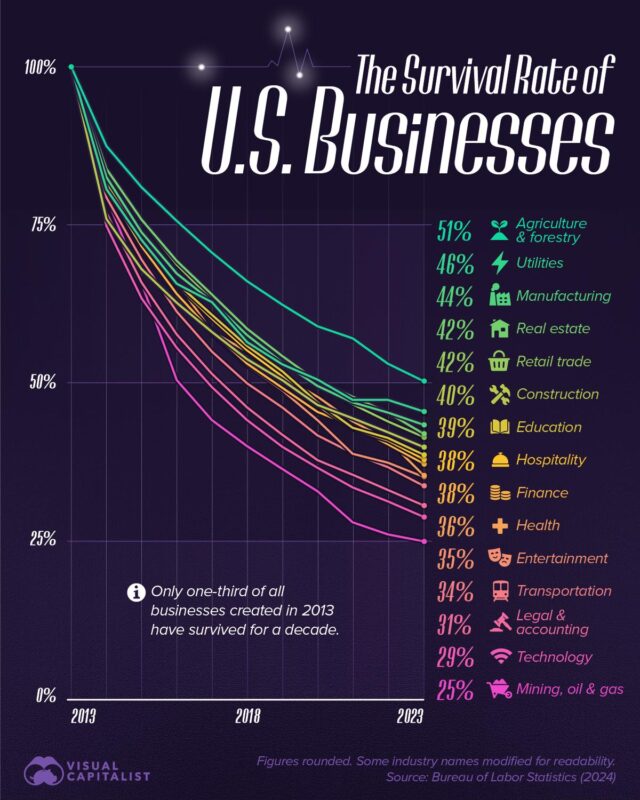
If you want to compare this with the US, our US business survival rates listing covers the American figures by industry and year.
Business survival rates by country
New businesses in the Netherlands have the best chance of lasting, with 95.9% surviving one year and 78.1% surviving three years. Lithuania sits at the other end, with 67.5% lasting one year and only 43.5% lasting three.
After the Netherlands, the best three-year survival rates were in Belgium (74.9%), Greece (72.5%) and Luxembourg (70.7%). The lowest were Lithuania (43.5%), Denmark (45.4%), Portugal (47.7%), France (48.9%) and Hungary (49.1%). Greek, Portuguese and French figures carry a break in series, so small differences between them are not meaningful.
A low survival rate is not always a bad sign. Countries with lots of start-ups, like Lithuania, Portugal and France, also tend to lose more of them, as people try ideas quickly and close the ones that don’t work.
Which industries have the highest business failure rates?
Transport and storage has the weakest survival record in the EU. Only 43.8% of transport businesses born in 2021 were still active three years later, and the sector had a provisional death rate of 12.0% in 2024, Eurostat’s bd_size data shows.
Administrative and support services (which includes things like cleaning, security, travel agencies and employment agencies) had both the highest birth rate of any sector, at 16.0%, and the highest provisional death rate, at 12.2%. Its three-year survival rate was 51.8%.
The most durable new businesses were in human health and social work (67.5% still active after three years), real estate (61.4%), manufacturing (60.1%) and information and communication (60.0%). Construction (58.3%), professional, scientific and technical services (58.5%) and wholesale and retail trade (53.7%) sat in between.
The UK shows the same weak spot. The Office for National Statistics says transport and storage has had the highest business birth and death rates in the UK every year since 2018, and only 17.2% of UK transport businesses born in 2020 survived five years.
Do businesses with employees survive longer?
Yes. New businesses that start with staff are much more likely to last than one-person businesses. In the EU, 79.1% of new enterprises with no employees survived their first year, compared with 87.6% of those with 1 to 4 employees and 91.9% of those with 5 to 9, according to Eurostat.
The gap is wider after three years. 55.4% of businesses that started with no employees were still active, against 65.3% for 1 to 4 employees and 71.5% for 5 to 9 employees. Businesses with 10 or more employees came in at 69.3%.
Those that survive also grow. Eurostat says 5-year-old enterprises employed 72% more people in 2024 than when they started in 2019, and 1-year-old enterprises employed 37% more.
Are business bankruptcies rising in Europe?
Yes. Bankruptcy declarations in the EU rose every quarter from late 2021 to the third quarter of 2025, dipped slightly over the next two quarters, then went up by 5.7% in the second quarter of 2026 to reach the highest level since early 2019, Eurostat’s quarterly figures show. New business registrations fell slightly in the same quarter, by 0.5%.
Eurostat links the sharp fall in bankruptcies in early 2020 to government support during the COVID-19 pandemic, which helped many businesses avoid declaring bankruptcy. Bankruptcies stayed well below their pre-pandemic level until late 2021.
A bankruptcy is only one way a business can die. Many businesses that close simply stop trading or are wound up by their owners, and Eurostat counts those as deaths too, as long as they are not mergers or takeovers.
How the UK compares
The UK’s business birth rate was 11.3% in 2025 and its death rate was 9.4%, the lowest death rate since 2006, the ONS reported on 19 November 2026. There were about 2.9 million active businesses, with 326,000 births and 271,000 deaths (the 2025 deaths are provisional).
The ONS also says 37.6% of UK businesses born in 2020 were still trading five years later. Northern Ireland had the best five-year survival rate (43.8%) and the West Midlands the lowest (34.6%).
The UK figures are only a rough comparison. They come from the UK’s Inter-Departmental Business Register, which counts VAT and PAYE registered businesses, while Eurostat’s figures come from each EU country’s statistical business register and cover a slightly different set of industries. The UK year is also a year ahead of the latest EU data.
What counts as a business birth or death?
An enterprise birth is a business that starts from scratch and begins operating, and an enterprise death is a business that stops for good, Eurostat’s glossary for births and deaths explains. Neither includes mergers, takeovers, break-ups or restructuring, and a dormant business that restarts within two years is not counted as a new birth.
The birth rate is the number of births divided by the number of active enterprises in the same year, and the death rate works the same way. A survival rate is the share of businesses born in a given year that are still active a set number of years later, as long as they keep the same business register number, even if they move, change owner or change what they do.
The figures cover industry, construction and most market services. They leave out farming, forestry and fishing, and public administration, Eurostat notes.
Questions about business birth and death rates
What percentage of new businesses fail in the first year?
In the EU about 19.5% of new businesses close within their first year. Eurostat data shows 80.5% of enterprises born in 2023 were still active in 2024. The rate varies a lot by country, from about 4% in the Netherlands to about 32% in Lithuania (our calculation from Eurostat’s survival rates).
What is the business survival rate after 3 years in Europe?
57.2% of EU businesses born in 2021 were still active in 2024. It ranged from 78.1% in the Netherlands to 43.5% in Lithuania.
Which EU country has the highest business birth rate?
Lithuania, with an enterprise birth rate of 17.5% in 2024. Portugal (16.1%), Malta (14.4%) and France (14.2%) came next. Austria had the lowest at 6.3%.
How many businesses are there in the EU?
There were 34.2 million active enterprises in the EU business economy in 2024, according to Eurostat. That count does not include farming, forestry, fishing or public administration.
Is a business death the same as a bankruptcy?
No. A business death is any business that stops operating for good, whether it goes bankrupt or the owner simply closes it. Bankruptcies are counted separately by Eurostat in its quarterly registrations and bankruptcies statistics.
Do more businesses open or close in the UK?
More open. In 2025 the UK had 326,000 business births and 271,000 business deaths, a birth rate of 11.3% against a death rate of 9.4%, according to the ONS.
Sources
- Eurostat, Business demography statistics, Statistics Explained (last edited 1 October 2026), the article the infographic comes from
- Eurostat, Business demography by size class and NACE Rev. 2 activity (bd_size), updated 23 October 2026
- Eurostat, Quarterly registrations of new businesses and declarations of bankruptcies, data released 17 August 2026
- Eurostat glossary, Enterprise birth, Enterprise death and Enterprise survival
- Office for National Statistics, Business demography, UK: 2025, released 19 November 2026, Open Government Licence v3.0
Eurostat material is reused under the Creative Commons Attribution 4.0 licence set out in Eurostat’s copyright notice. The infographic is shown unchanged. Figures marked as our calculation were worked out by us from Eurostat data, and Eurostat is not responsible for them.