Key points from the chart
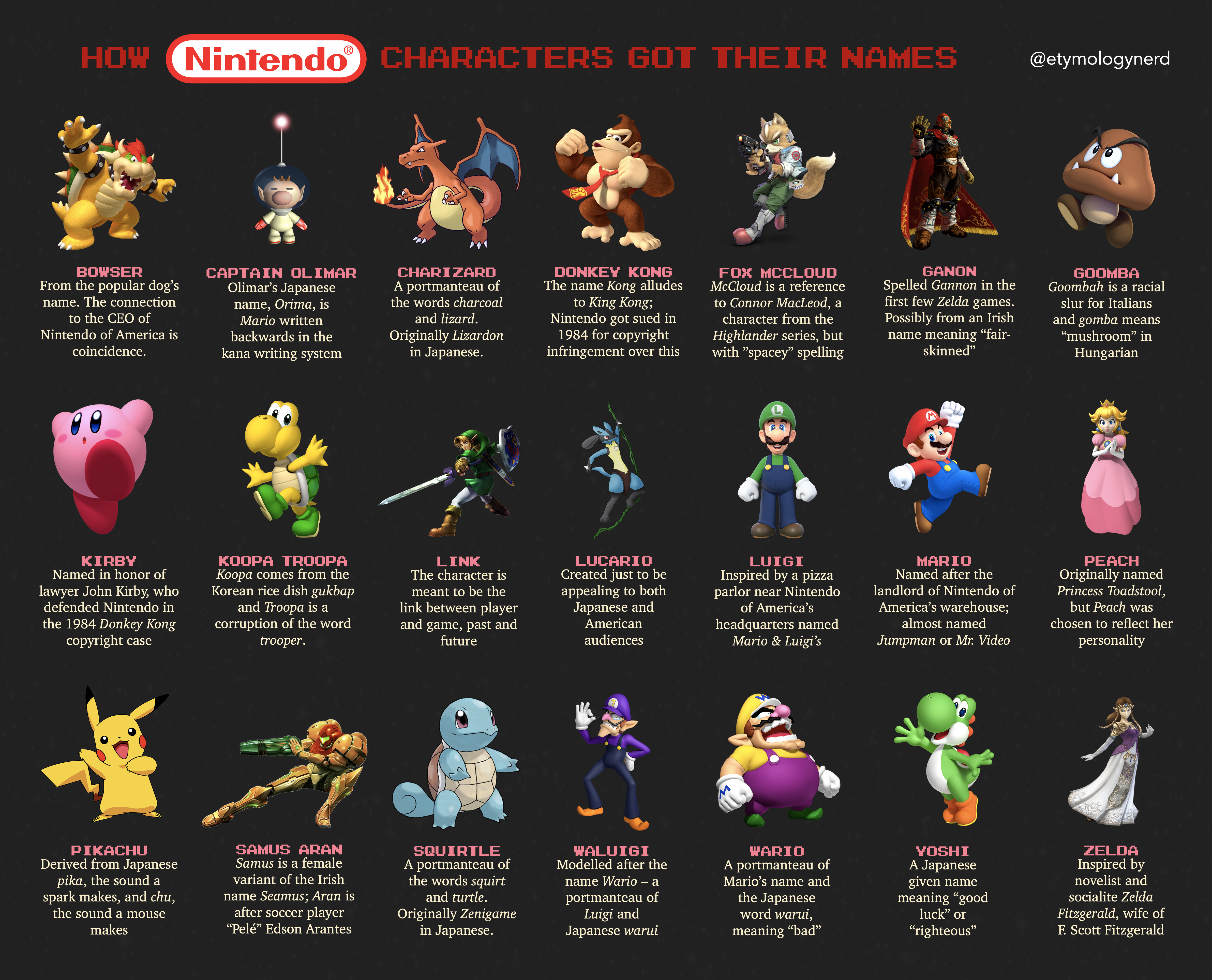
- The chart explains 21 Nintendo character names, from Bowser to Zelda, in alphabetical order across three rows of seven.
- Several names come from real people: Mario from a landlord, Kirby from a lawyer, Zelda from Zelda Fitzgerald and Samus Aran’s surname from Pelé.
- Four names draw on Japanese or Korean words: Wario and Waluigi use the Japanese warui (“bad”), Pikachu combines two Japanese sound words, and Koopa traces to the Korean dish gukbap.
- Three Pokémon names (Charizard, Squirtle, Pikachu) are explained, two of them as English portmanteaus that replaced the Japanese names Lizardon and Zenigame.
- The chart is signed @etymologynerd and cites no sources.
Every Nintendo character name on the chart
Title: How Nintendo Characters Got Their Names. The middle column keeps the chart’s wording. The right column is our check against the Wikipedia article for each character, opened in October 2026.
| Character | What the graphic says | Our check |
|---|---|---|
| Bowser | From the popular dog’s name. The connection to the CEO of Nintendo of America is coincidence. | Unconfirmed. Wikipedia lists the pet name as one of several theories. His Japanese name, Kuppa, came from the Japanese pronunciation of the Korean dish gukbap [1]. |
| Captain Olimar | Olimar’s Japanese name, Orima, is Mario written backwards in the kana writing system | Confirmed. Olimar (Orimā) is an anagram of Mario [2]. |
| Charizard | A portmanteau of the words charcoal and lizard. Originally Lizardon in Japanese. | Confirmed [3]. |
| Donkey Kong | The name Kong alludes to King Kong; Nintendo got sued in 1984 for copyright infringement over this | Partly. Universal alleged trademark infringement, not copyright, and Wikipedia dates the case to 1983. Universal lost [4]. |
| Fox McCloud | McCloud is a reference to Connor MacLeod, a character from the Highlander series, but with “spacey” spelling | Partly. Wikipedia says McCloud was a play on the Scottish Gaelic name McLeod. It does not mention Highlander [5]. |
| Ganon | Spelled Gannon in the first few Zelda games. Possibly from an Irish name meaning “fair-skinned” | Spelling confirmed for the Japanese versions of the first three games [6]. The Irish origin is not confirmed. |
| Goomba | Goombah is a racial slur for Italians and gomba means “mushroom” in Hungarian | Confirmed. Wikipedia describes goombah as Italian-American slang and notes the Hungarian gomba [7]. |
| Kirby | Named in honor of lawyer John Kirby, who defended Nintendo in the 1984 Donkey Kong copyright case | Confirmed, with the same date and wording issue as Donkey Kong [4][8]. |
| Koopa Troopa | Koopa comes from the Korean rice dish gukbap and Troopa is a corruption of the word trooper. | Koopa part confirmed through Bowser’s Japanese name, Kuppa [1]. |
| Link | The character is meant to be the link between player and game, past and future | Confirmed for past and future [9]. |
| Lucario | Created just to be appealing to both Japanese and American audiences | Confirmed in part. Junichi Masuda said the name was hard to create because it had to appeal to all audiences [10]. |
| Luigi | Inspired by a pizza parlor near Nintendo of America’s headquarters named Mario & Luigi’s | Unconfirmed. IGN, cited by Wikipedia, lists this as one theory alongside a rhyme on a Japanese word [11]. |
| Mario | Named after the landlord of Nintendo of America’s warehouse; almost named Jumpman or Mr. Video | Confirmed. The landlord was Mario Segale [12]. |
| Peach | Originally named Princess Toadstool, but Peach was chosen to reflect her personality | Partly. In Japan she was always Princess Peach; Toadstool was the English localisation [13]. |
| Pikachu | Derived from Japanese pika, the sound a spark makes, and chu, the sound a mouse makes | Confirmed [14]. |
| Samus Aran | Samus is a female variant of the Irish name Seamus; Aran is after soccer player “Pelé” Edson Arantes | Aran confirmed: from Edson Arantes do Nascimento, Pelé’s birth name [15]. Samus not confirmed. |
| Squirtle | A portmanteau of the words squirt and turtle. Originally Zenigame in Japanese. | Confirmed [16]. |
| Waluigi | Modelled after the name Wario, a portmanteau of Luigi and Japanese warui | Confirmed. Warui means “bad” [17]. |
| Wario | A portmanteau of Mario’s name and the Japanese word warui, meaning “bad” | Confirmed [18]. |
| Yoshi | A Japanese given name meaning “good luck” or “righteous” | Not checked against a source. |
| Zelda | Inspired by novelist and socialite Zelda Fitzgerald, wife of F. Scott Fitzgerald | Confirmed by Shigeru Miyamoto [19]. |
Where Nintendo character names come from
The chart shows three patterns. The first is naming after people connected to Nintendo of America. Mario was named after Mario Segale, the landlord of Nintendo of America’s warehouse; before that the character had been called Jumpman and, by Shigeru Miyamoto, Mr. Video [12]. Kirby was named in honour of John Kirby, the lawyer who represented Nintendo when Universal claimed Donkey Kong infringed its King Kong trademark. Judge Robert W. Sweet ruled that Universal had acted in bad faith [4][8].
The second is localisation. When the first Pokémon games were translated, Nintendo gave species “clever and descriptive” English names, which is how Lizardon became Charizard and Zenigame became Squirtle [3][16]. Peach’s Japanese name was always Princess Peach; English manuals called her Princess Toadstool until the 1990s [13].
The third is wordplay in Japanese. Wario and Waluigi both take warui, “bad”, so the names mean “bad Mario” and “bad Luigi” [17][18]. Olimar, written Orimā in Japanese, is an anagram of Mario [2].
Notes on this infographic
- Donkey Kong case. The chart calls it a 1984 copyright case. Wikipedia describes Universal City Studios v. Nintendo as a 1983 case about trademark infringement [4].
- Theories presented as fact. Bowser and Luigi are given single explanations, but Wikipedia records them as unconfirmed theories [1][11]. The Ganon (Irish), Samus (Seamus) and Yoshi meanings were not found in the sources we checked.
- Fox McCloud. Wikipedia links the name to the Scottish name McLeod, not to Highlander [5].
Questions about Nintendo character names
How did Nintendo get its name?
The name is often said to mean “leave luck to heaven”, but Wikipedia notes there is no historical evidence for that, and even Fusajiro Yamauchi’s descendants do not know the intended meaning. Yamauchi founded the company in Kyoto in 1889 to make hanafuda playing cards [20].
What does Bowser mean in Japanese?
Bowser’s Japanese name is Kuppa (Koopa). It came from the Japanese pronunciation of gukbap, a Korean dish [1].
Sources
- Wikipedia, Bowser (character).
- Wikipedia, Captain Olimar.
- Wikipedia, Charizard.
- Wikipedia, Universal City Studios, Inc. v. Nintendo Co., Ltd..
- Wikipedia, Fox McCloud.
- Wikipedia, Ganon.
- Wikipedia, Goomba.
- Wikipedia, Kirby (character).
- Wikipedia, Link (The Legend of Zelda).
- Wikipedia, Lucario.
- Wikipedia, Luigi (character).
- Wikipedia, Mario.
- Wikipedia, Princess Peach.
- Wikipedia, Pikachu.
- Wikipedia, Samus Aran.
- Wikipedia, Squirtle.
- Wikipedia, Waluigi.
- Wikipedia, Wario.
- Wikipedia, Princess Zelda.
- Wikipedia, Nintendo.
- Etymology Nerd, infographics page, where the creator lists this chart.
Last reviewed 29 October 2026