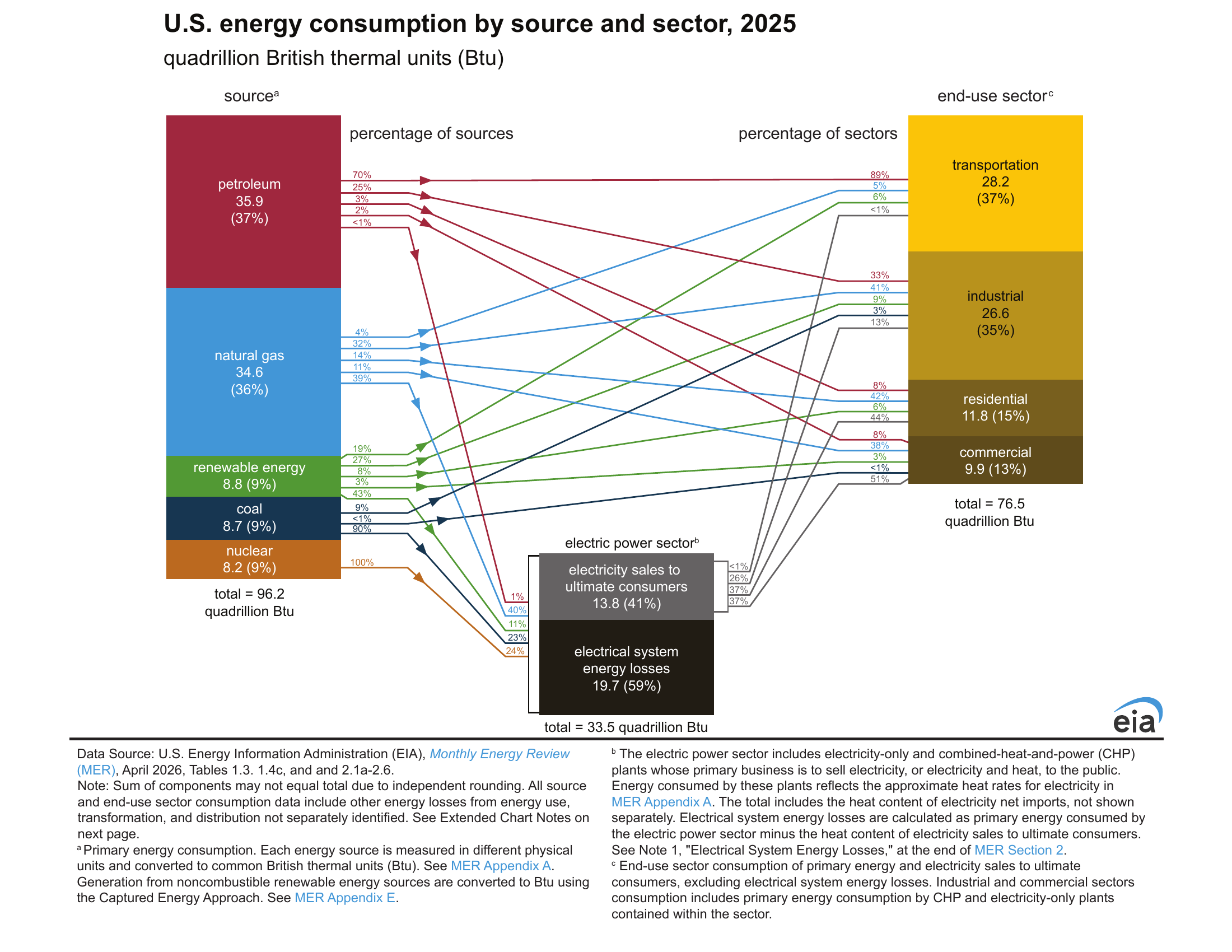
The US gets most of its energy from petroleum and natural gas. In 2025 the country used 96.5 quadrillion British thermal units (quads) of primary energy, and petroleum supplied 37% of it, natural gas 36%, renewables 9%, coal 9% and nuclear power 8.5%, according to the U.S. Energy Information Administration’s Monthly Energy Review. Fossil fuels together still made up 82% of the total.
Where the US gets its energy
Petroleum is the largest single source of energy in the US, just ahead of natural gas, and the two together supply almost three quarters of everything the country uses. The figures below are EIA’s latest annual totals for 2025 from Monthly Energy Review Table 1.3.
| Energy source | Quads used in 2025 | Share of US energy |
|---|---|---|
| Petroleum | 36.1 | 37.4% |
| Natural gas | 34.6 | 35.9% |
| Renewable energy | 8.8 | 9.2% |
| Coal | 8.7 | 9.0% |
| Nuclear power | 8.2 | 8.5% |
| Total | 96.5 | 100% |
The infographic by the U.S. Energy Information Administration was drawn from the April 2026 edition of the Monthly Energy Review, which put the 2025 total at 96.2 quads and petroleum at 35.9 quads. EIA has since revised those preliminary figures slightly upwards, so the table uses the current numbers. The shares barely move.
A quad is a quadrillion Btu, a 1 followed by 15 zeros, and EIA uses it to put fuels measured in barrels, cubic feet and tons on the same scale. You can see how it converts each fuel on its British thermal units page. US energy use rose about 2% in 2025, from 94.6 quads in 2024.
How much US energy is renewable
About 9% of the energy the US used in 2025 came from renewable sources, a record 8.8 quads, according to EIA’s renewable energy FAQ and Table 1.3. Biomass is still the biggest renewable source once you count wood, biofuels and waste, and solar is the fastest growing.
- Biomass (wood, biofuels such as ethanol, and waste) 4.9 quads
- Wind 1.6 quads
- Solar 1.4 quads, up 26% on 2024
- Hydropower 0.8 quads
- Geothermal 0.1 quads
Renewables look much bigger in the electricity mix, where they made about 24% of utility-scale power in 2025, according to EIA’s Electricity in the United States page. The two figures measure different things. Primary energy counts all the fuel that goes into power stations, including the heat they lose, while the electricity mix counts only the kilowatthours that come out. Since the September 2023 edition of the Monthly Energy Review, EIA has measured wind, solar and other non-combustion renewables used for electricity with what it calls the captured energy approach, so check which method a figure uses before comparing it with older data.
Which sectors use the most energy
Transportation uses the most energy in the US, closely followed by industry, while homes and businesses use far less. EIA splits use into four end-use sectors. In 2025, measured as the fuel they burn directly plus the electricity they buy, transportation used 28.3 quads (37%), industry 26.7 quads (35%), homes 11.9 quads (15%) and commercial buildings 9.9 quads (13%), out of 76.8 quads, according to Monthly Energy Review Table 2.1.
| Sector | Energy used in 2025 | Main energy sources |
|---|---|---|
| Transportation | 28.3 quads | Petroleum 89%, biofuels 6%, natural gas 5% |
| Industrial | 26.7 quads | Natural gas 41%, petroleum 33%, electricity 13%, renewables 9% |
| Residential | 11.9 quads | Electricity 43%, natural gas 42%, petroleum 8% |
| Commercial | 9.9 quads | Electricity 51%, natural gas 38%, petroleum 8% |
The source mix for each sector comes from EIA’s sector tables (2.2, 2.3, 2.4 and 2.5). If you add each sector’s share of the energy lost in making its electricity, industry moves to the top at 31.7 quads, because homes and offices buy so much of their energy as electricity.
What petroleum and natural gas are used for
Most US petroleum goes into vehicles, while natural gas is split between power stations, industry and heating. About 70% of the petroleum used in 2025 went to transportation and another 25% to industry, where it is used both as a fuel and as a raw material, on EIA’s sector figures in Table 2.5 and Table 2.4. Homes, offices and power stations use very little of it.
Natural gas is the more flexible fuel. In 2025, 39% of it was burned to make electricity, 32% was used by industry, 14% heated homes and 11% heated commercial buildings, with the last 4% used in transportation. Coal and nuclear power are almost entirely about electricity. EIA’s Table 2.6 shows 90% of coal and all nuclear energy went to power stations. Renewables are spread more widely, with 43% used for electricity, 27% in industry (almost all of it biomass) and 19% in transport as biofuels.
How much energy is lost making electricity
Close to 60% of the energy that goes into US power stations is lost before it reaches anyone. In 2025 the electric power sector used 33.5 quads of primary energy, about a third of the national total, but sold just 13.8 quads of electricity to customers. The other 19.7 quads, or 59%, were electrical system energy losses, the energy lost in generating, transmitting and distributing that electricity, according to Monthly Energy Review Table 2.1.
Natural gas fuelled 40% of the energy going into power stations in 2025, nuclear 24%, coal 23% and renewables 11%, on EIA’s Table 2.6. Measured by the electricity actually generated, natural gas made about 41% of US utility-scale power, renewables 24%, nuclear 18% and coal 17%, out of about 4.43 trillion kilowatthours, according to EIA. Wind was the largest renewable source of electricity at about 11%, followed by solar at 7% and hydropower at 6%.
How the US energy mix has changed
Natural gas has taken a much bigger share of US energy since 1950 and coal a much smaller one, while petroleum has stayed on top. EIA’s US energy facts show coal fell from about 37% of US energy use in 1950 to 9% in 2025, mostly because power stations switched to other fuels. Natural gas went the other way, from about 18% in 1950 to 36%. Petroleum’s share peaked at about 49% in 1978.
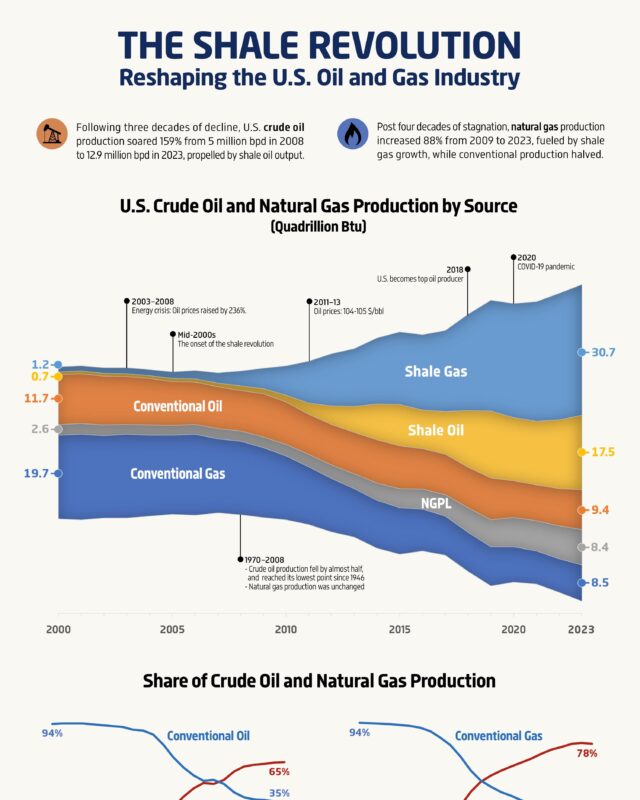
The US also now produces more energy than it uses. Production first passed consumption in 2019, and in 2025 the country produced 107.2 quads and exported 11.1 quads more than it imported, according to Monthly Energy Review Table 1.1. Natural gas was the biggest source of production at 38%, followed by crude oil at 26.5%, and EIA’s energy facts page says crude oil and renewable production both reached records in 2025.
Questions about US energy sources
What is the largest source of energy in the United States?
Petroleum. It supplied 36.1 quads, or 37% of US primary energy use, in 2025, just ahead of natural gas at 34.6 quads (36%), according to EIA’s Monthly Energy Review. Natural gas is the largest source of US electricity and of US energy production.
What percentage of US energy is renewable?
About 9%. Renewable sources supplied 8.8 quads of the 96.5 quads the US used in 2025, a record. Renewables made a larger share of electricity, about 24% of utility-scale generation, according to EIA.
How much energy does the US use each year?
The US used 96.5 quadrillion Btu of primary energy in 2025, on EIA’s latest figures, up from 94.6 quads in 2024. About a third of that goes into power stations, and more than half of the energy they use is lost in generating and delivering electricity.
Which sector uses the most energy in the US?
Transportation, at 28.3 quads or 37% of energy used by end-use sectors in 2025, just ahead of industry at 35%. When the energy lost making each sector’s electricity is added, industry uses the most.
What does a quad of energy mean?
A quad is one quadrillion British thermal units. EIA uses it to compare fuels that are measured in different physical units, such as barrels of oil, cubic feet of gas and tons of coal.
Sources
- U.S. Energy Information Administration, U.S. energy consumption by source and sector, 2025 (chart from the Monthly Energy Review, April 2026)
- U.S. Energy Information Administration, Monthly Energy Review (October 2026 release), Tables 1.1, 1.2, 1.3, 2.1a, 2.1b and 2.2 to 2.6
- U.S. Energy Information Administration, U.S. energy facts explained
- U.S. Energy Information Administration, Electricity in the United States
- U.S. Energy Information Administration, How much of U.S. energy production and consumption comes from renewable energy sources?
- U.S. Energy Information Administration, British thermal units (Btu)